References
Why tech bros are crawling out of their dark corners for the bright fashion spotlight
Written and edited by Niclas Kauermann
For years, the tech elite remained largely absent from the cultural spotlight. But in recent months, that has changed. Mark Zuckerberg appeared in Prada's front row, while Jeff Bezos became a major backer of the Met Gala. This unexpected move into fashion by notoriously low-profile billionaires can be seen as a form of "culture washing." Their growing presence has sparked concern across the industry. And yet, this development may also carry a positive message for the fashion environment.
On a sunny Sunday in June 1914, a black car drives through the crowded streets of the Bosnian capital, Sarajevo. In the back seat sits a man wearing a light blue jacket, bright red trousers and a large hat with a feather, adorned with medals from head to toe. Shortly afterwards, a person in a classic black suit steps out of the crowd. He pulls a pistol from his pocket and fires two shots at the man in the light blue jacket. It is the assassination of the Austro-Hungarian heir to the throne, Archduke Franz Ferdinand, and at the same time the start of the world's first global war.
A few years later, Lenin and his Bolsheviks knocked on the gates of the Winter Palace of the white-clad Tsar Nicholas II and seized power. As the First World War came to an end in 1918, the remaining European empires began to falter, giving way to the age of republics. Yet, it was not only the form of government that changed, but also its appearance.
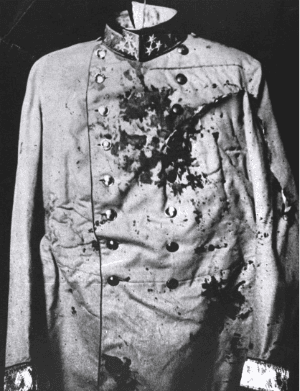
Franz Ferdinand's blood-stained uniform – Source: LIFE Magazine, from an earlier, unnamed source., Public Domain, https://commons.wikimedia.org/w/index.php?curid=33486635
In the post-war climate, characterized by increasingly vocal labor movements, it became progressively important for the elite not to attract attention. To avoid being seen as an easily identifiable enemy, the elite altered their appearance in a way that the British philosopher John Flügel describes as the ‘Great Male Renunciation’. From now on, the black suit replaced ornate, colourful outfits in order to blend in better with the population and make it harder to identify social class differences. One became invisible to revolutionaries.
And this dressing philosophy has been carried out for years. To adopt a military appearance, Joseph Stalin wore a peaked cap, Francisco Franco a field cap, and Adolf Hitler the same brown shirts as his SA men. By mimicking the appearance of the working class, the elite managed to conceal their true nature.
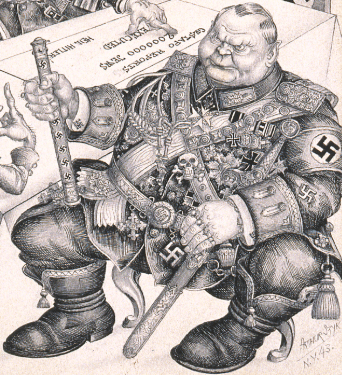 |  |
Left: Caricatures by Arthur Syzk criticising Hermann Göring’s flamboyance – Source: The Arthur Szyk Society, Burlingame, CA (www.szyk.org)
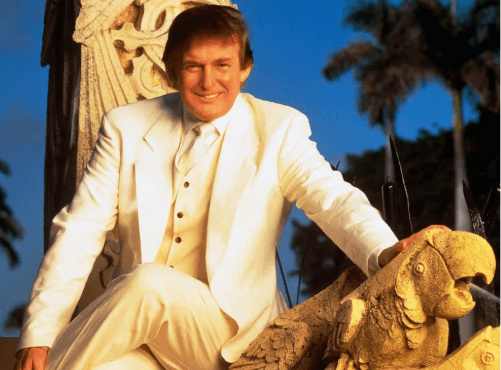
Right: Donald Trump in Playboy Magazine 1996 – Source: BY BRIAN SMITH/CORBIS OUTLINE.
Anyone who opposed that approach had to expect consequences. Hermann Göring rejected this utilitarian style and chose a more eccentric dress sense. With his white, decorated suits and long capes, he quickly became a laughingstock, both in enemy countries and amongst his own brown-shirted people. Even within his own ranks, he was criticized for his appearance. Joseph Goebbels, for instance, described his colleague’s appearance as ‘somewhat funny’.
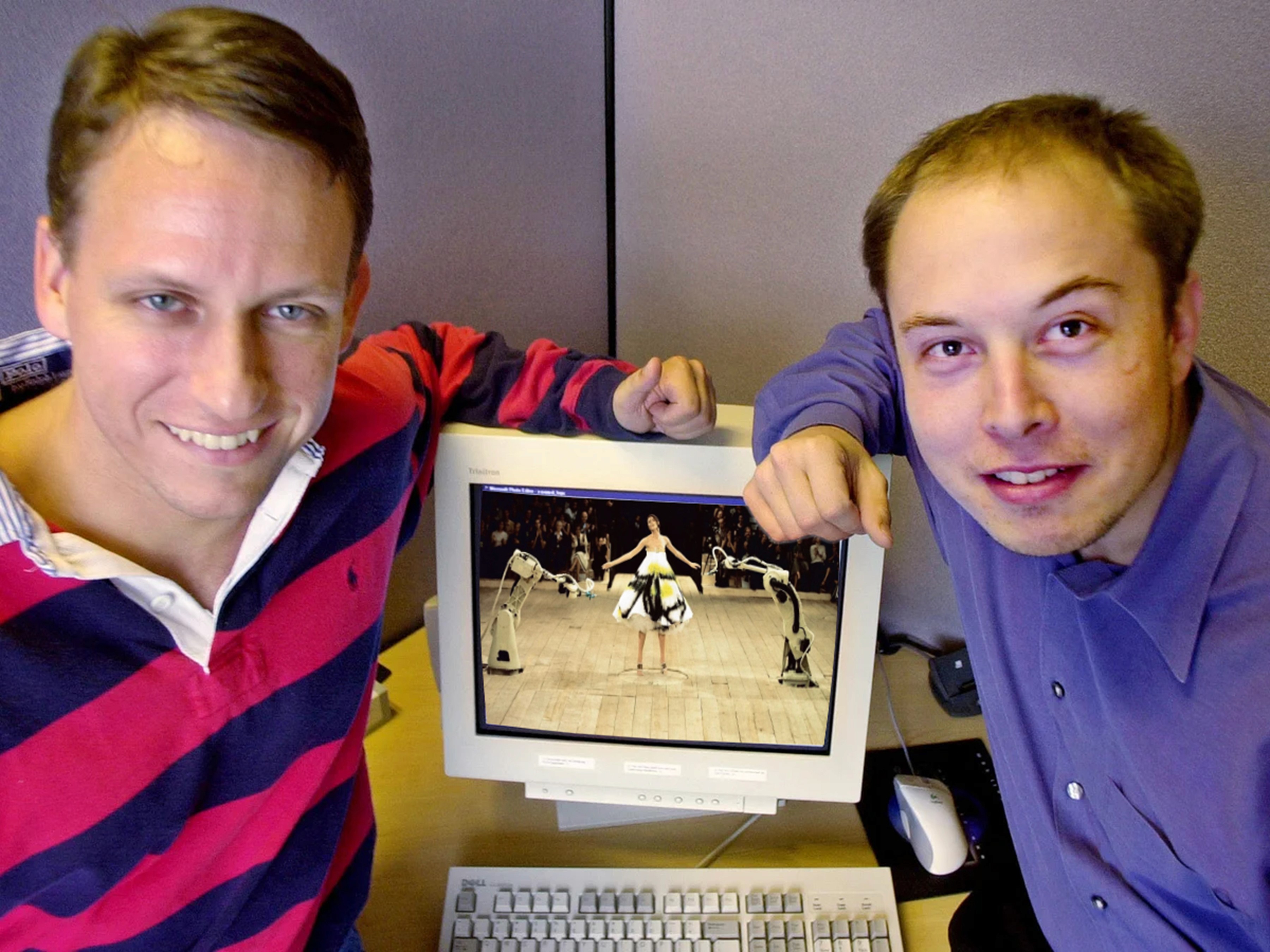
The tactic of adopting a neutral appearance to protect oneself from the public thus remained in place. With the internet boom and the rise of Silicon Valley in the 1990s, a new ‘upper class’ emerged: the tech elite. And this group, too, had to protect itself from potential ridicules or new Lenins who might one day come knocking at their door. Consequently, they selected a generic uniform so as not to stand out. Steve Jobs is probably the best-known example of this, with his unassuming Issey Miyake turtleneck and blue jeans. Mark Zuckerberg chose a ‘simple’ grey T-shirt by Brunello Cucinelli, and Peter Thiel left his tie off and the top button of his shirt undone. The aim of this appearance was clear: not to stand out. To make objective class distinctions disappear.
 |  |
Left: Mark Zuckerberg (2018) Source: By Anthony Quintano from Honolulu, HI, United States - Mark Zuckerberg F8 2018 Keynote, CC BY 2.0, https://commons.wikimedia.org/w/index.php?curid=70827607
Right: Mark Zuckerbergs (2025) Source: https://www.youtube.com/watch?v=YuIc4mq7zMU
For years, this tech elite tried to hide from the public eye and only made an appearance once in a while, when, for example, a new iPhone was launched. They tried not to draw attention to themselves and to keep their wealth to themselves.
But that seemed to change suddenly. At the Prada Autumn/Winter 2026 show, alongside fashion influencers and South Korean actors, sat Meta owner Mark Zuckerberg. The man who, just a few years earlier, had described fashion as ‘silly or frivolous in [his] life’.
Even before his front-row appearance, he had frequently been spotted wearing “cool” streetwear T-shirts featuring historical slogans such as ‘Pathei Mathos’ (Greek for ‘learning through suffering’) or ‘Carthago delenda est’ (Latin for ‘Carthage must be destroyed’). Two years earlier, Jeff Bezos attended the Dolce & Gabbana Autumn/Winter 2024 show dressed as a Vin Diesel cosplay.
Most recently, the Amazon owner attracted attention for sponsoring the Met Costume Institute’s new exhibition, “Costume Art”. Meanwhile, Peter Thiel (the man who doesn’t believe humanity should be wiped out, “but…”) is supporting American fashion designer Elena Velez, on whose runway internet beauty guru Clavicular was walking. Meanwhile, across the Atlantic, Bryan Johnson was walking the Matières Fécales show.
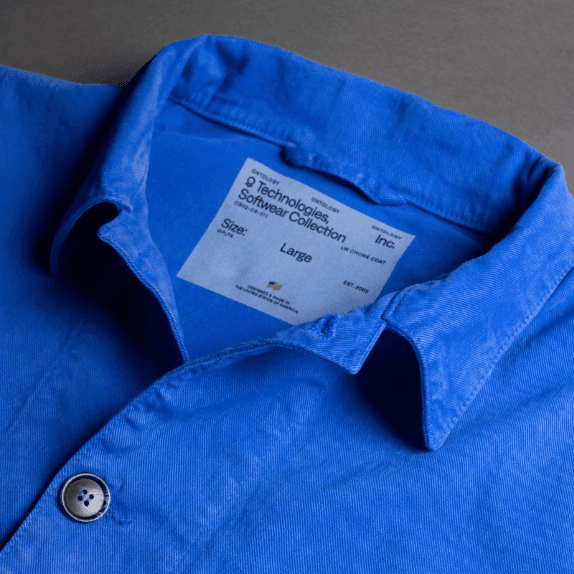
Palantir’s blue chore coat. - Photograph: Palantir
And the list goes on: Google has been working with Kering on smart glasses since last year. OpenAI is having former Apple design chief Jony Ive develop its upcoming products. Meta is opening a luxury store in New York alongside Prada and Dolce & Gabbana. And Peter Thiel, through his company Palantir – which supports both the immigration agency ICE and the Israeli military with its surveillance infrastructure – is launching workwear jackets with an embroidered logo. The tech elite has emerged from the underground. Hiding in grey T-shirts has been abandoned, and they are stepping radically into the glittering spotlight of fashion.
But this raises the question: why all this? Why is it suddenly no longer important to conceal social differences? Well, to put it simply: the tech bros have been undone by their own product.
In this age of the ‘all-knowing’ internet, it’s no longer possible to hide. If, for example, Jeff Bezos goes on holiday aboard his superyacht, the internet finds out about it, whether he likes it or not. And thanks to the annual Forbes lists, we always know exactly who the rich and famous of this world are and how much money they have in their pockets.
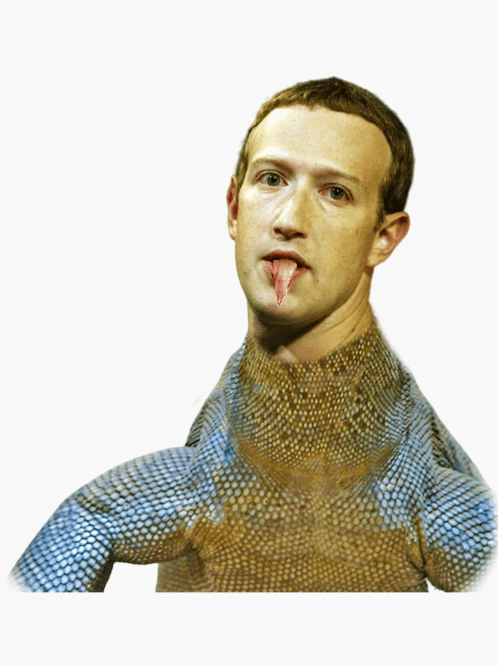
Mark Zuckerberg as a lizard – Source: Redbubble
The internet knows everything. And if there is ever something it doesn’t know, that gap in knowledge is simply filled in by conspiracy theories. Peter C. Baker explains the emergence of these theories by saying that any absence of information “creates a void into which every scrolling viewer can instantly project whatever suspicion they’re already disposed to.” And this is precisely where the elite’s hide-and-seek becomes a problem. The absence of any display of their wealth creates a knowledge gap which conspiracy theories can step into.
In 2016, for example, conspiracy theorist David Icke attributed Mark Zuckerberg’s reserved behaviour to the fact that he is a reptilian hybrid who, together with his ‘kin’ and followers – such as Angela Merkel – secretly rules the world. This reserved behaviour on the part of the elite and the resulting lack of information give rise to theories that ultimately turn against them.
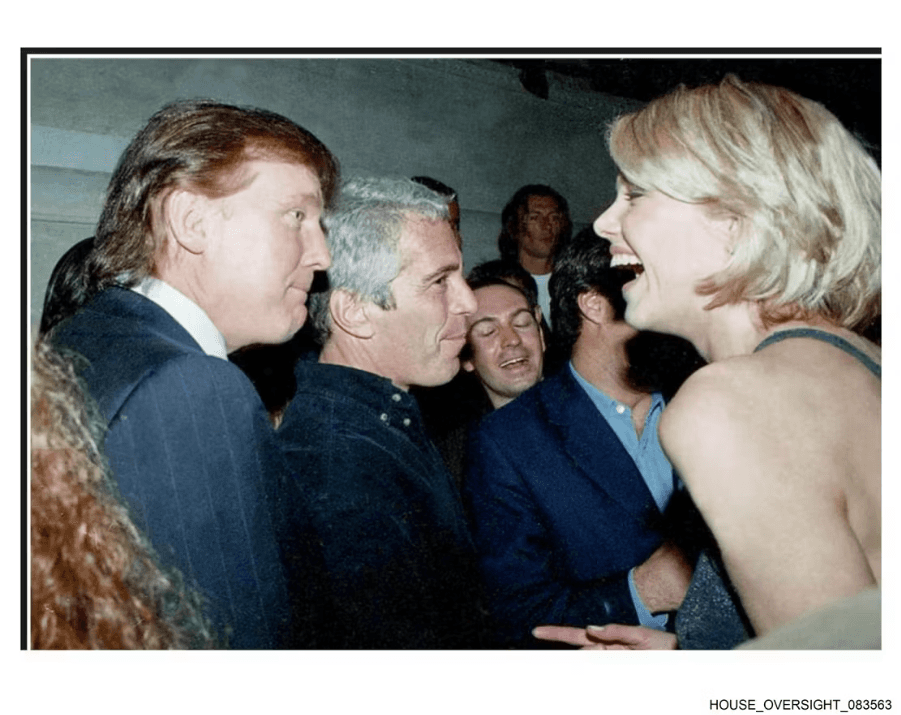
This undated photo from the personal collection of Jeffrey Epstein provided by the Democrats on the House Oversight Committee on December 12, 2025, shows US President Donald Trump (L), flanked by Epstein (C), talking to an unknown woman. - Source: HANDOUT / AFP
With the Jeffrey Epstein Files and the theories circulating, it became clear that if you try to hide from the public, you are quickly cast as a villain by the internet. Donald Trump, who initially used this villainous image to rail against his political opponents during the election campaign, later became part of it himself when he briefly refused to release the files. If the tech elite may have learned one thing in recent months, it is that hiding from the public eye can backfire.
By stepping into the spotlight, it also becomes much easier to help shape one’s public image and influence it according to one’s own vision. Palantir’s fashion collections are perhaps the most obvious example of this: if you manage to ensure that your logo is seen not only in a military context but also on trendy streetwear, you automatically soften the hate-filled image. You cleanse your name through various appearances.
The appearance of tech elites such as Jeff Bezos at the Met Gala may well serve a similar purpose. It provides the internet with a new talking point about oneself, without having to address the appalling working conditions in their companies. It is less about covering up or even solving their own problems, and more about presenting an alternative topic for influencers and the media to discuss. In this way, these problems are simply buried beneath a flood of content in the depths of algorithmic feeds. Stepping into the spotlight thus becomes a matter of hiding.
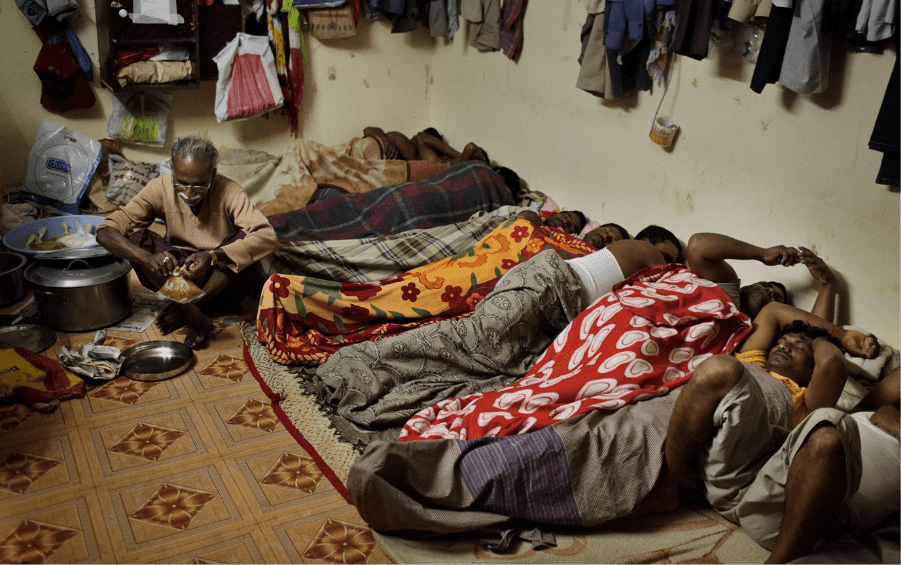
Migrant construction workers sleep on the floor in Dubai in 2012. Source: by Jonas Bendickson/Magnum
Looking at other cultural industries, this strategy has been evident for some time now. For years, Arab leaders and businesspeople have been investing in football. The Vice-President of the United Arab Emirates, Mansour bin Zayed Al Nahyan, bought football the club Manchester City in 2008, the Qatari government took over Paris Saint-Germain in 2011, and the Saudi Arabian government acquired Newcastle United in 2021.
Countries realised that it was not feasible to participate in global trade whilst simultaneously isolating themselves from the world in order to quietly continue to oppress women or persecute homosexuals. This gave rise to what is known as ‘sportwashing’, whereby sports clubs, high-profile players or even entire World Cups are bought off. The aim is to improve a controversial image in the Western world through targeted attention and distraction.
Similar patterns can be seen in the tech elite’s recent affection for the fashion industry, an attempt to purify their public image and make the leap into the ranks of the chic social elite. However, the connection between tech bros and fashion is nothing new. In 2014, Google collaborated with Diane von Furstenberg to showcase her glasses. And back in 2012, Jeff Bezos already sponsored the Met Gala of the time with Amazon (though not yet in his macho Vin Diesel look, but still in an understated suit with a crooked bow tie).
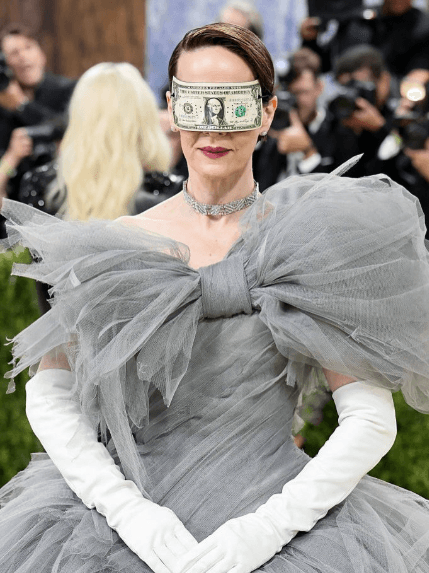
Sarah Paulson at The Met Gala wearing Matières Fécales FW26 “The One Percent” Haute Couture – Source: Insagram (@matieresfecales)
And the fashion industry is simply allowing this appropriation to happen. Much like in football, under a corrupt FIFA, the fashion industry is all too easily blinded by large cheques. Even though it may come as a shock to the influencer Lyas that Interview Magazine is suddenly collaborating with the Republican mayoral candidate for Los Angeles, Spencer Pratt (Lyas took his video down a little later), the reality is that the fashion industry has shifted toward a more conservative and apolitical stance for years.
As a detailed article in M Le magazine du Monde from last September describes, diversity roles in fashion houses are being cut, skinny models are back, and activism is taking a back seat to empty spectacle. “Pride is turning beige.” This barren political landscape makes it all the easier for the tech elite to carry out their image-building PR campaigns undisturbed.

Mark Zuckerberg and Priscilla Chan front row at the Prada fashion show - Source: Vanessa Friedman on X @VVFriedman
But what does this new venture by the tech bros actually mean for the wider public? On the one hand, it’s worth noting that there are positive aspects to be gleaned from these efforts by the elite to clean up their image. After all, it means they still care about us. Our reputation and our opinion apparently still carry enough weight that Mark Zuckerberg is willing to sacrifice his precious time for a - according to Philippe Pourhashemi - “AWFUL AND TERRIBLY EMBARRASSING” Prada show.
And this could also have a positive outcome for the fashion industry. Let’s take another look at football. In Europe, there is still one country standing in the way of millionaires’ attempts to ‘image-wash’ themselves by buying up clubs. In Germany, it is not permitted to purchase more than 50% of the shares in a club. As a result, the Bundesliga is the only European league that is not yet completely dominated by Saudi and Qatari sheikhs. At the same time, the German league has consistently recorded the highest stadium attendance figures in recent years.
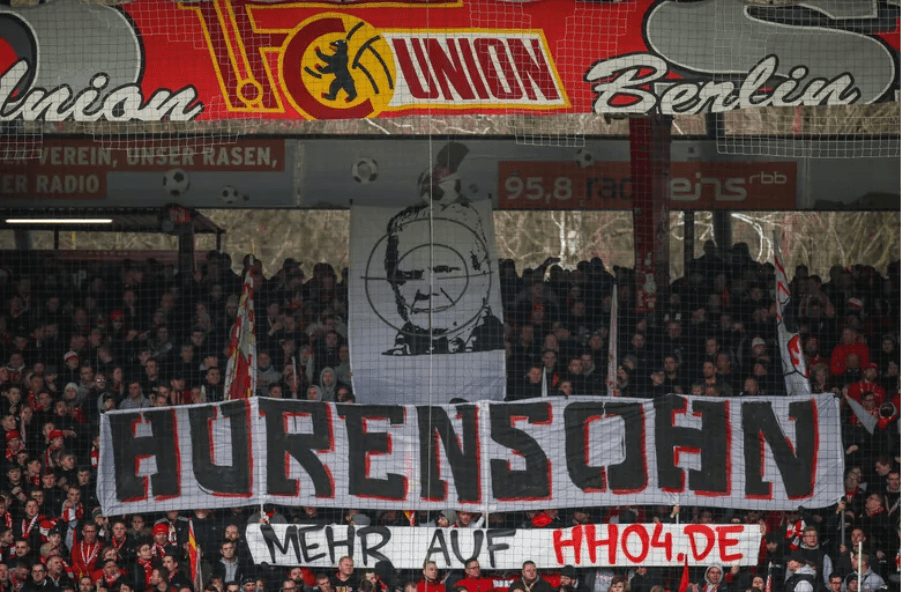
‘Son of a bitch’ banner, directed at TSG Hoffenheim investor Dietmar Hopp, raised by German football fans – Source: Andreas Gora/dpa via AP
It seems that millionaires’ attempts to polish their image can also lead to greater support for smaller football clubs. This is evident in German football culture, which is frequently praised by the international press for an atmosphere that is “nothing like it at home [in England]”. Here, fans actively seek to protect their clubs from outside investors, for example by contributing to stadium construction or even donating blood to support their teams financially.
If the tech elite try to buy their way into major fashion houses and brands, this could also lead to increased support for smaller and up-and-coming designers. Similar to German football, it might foster stronger solidarity among independent brands and their audiences. Ultimately, the power lies with consumers: whether they go along with the image campaign being run by Mark Zuckerberg, or break free from the industry’s commercialism.

Tesla Cybertruck Presentation (2019) – Source: Youtube (@Tesla)
On the other hand, it could already be too late for us. Perhaps Mark Zuckerberg really is a Prada fan and can finally enjoy this passion undisturbed. Perhaps the days when the elite had to hide are just over. Perhaps they now dare to emerge from their safe havens, because they no longer fear the public. Because they know that today they can wear a light blue suit again without having to fear ridicule or an assassination attempt. Because they know that the car driving through Sarajevo today has bulletproof windows.
Doc/34 all rights reserved, sponsored by IFM.
" height="65.65946764590899px" id="biO_icj08" transform="translate(0 1.371)" width="59.174572953517554px"/><path d="M 63.167 33.692 C 63.167 54.377 50.565 68.088 31.544 68.088 C 12.524 68.088 0 54.69 0 33.927 C 0 13.163 12.371 0 31.626 0 C 50.882 0 63.17 13.163 63.17 33.692 Z M 46.89 33.848 C 46.89 21.155 41.097 13.477 31.626 13.477 C 22.155 13.477 16.206 21.234 16.206 33.848 C 16.206 46.463 22.077 54.533 31.626 54.533 C 41.176 54.533 46.89 46.698 46.89 33.848 Z" fill="rgb(0, 0, 0)" height="68.08839784893921px" id="A8_8V8D77" transform="translate(58.705 0.196)" width="63.17042207703656px"/><path d="M 43.755 24.133 C 42.268 17.003 38.119 13.477 31.388 13.477 C 21.838 13.477 16.281 20.998 16.281 33.927 C 16.281 46.855 22.073 54.455 31.779 54.455 C 36.084 54.455 39.763 52.653 42.033 49.519 C 43.363 47.638 43.911 46.071 44.381 42.781 L 60.662 45.209 C 59.175 51.869 57.453 55.709 54.165 59.548 C 49.312 65.111 41.72 68.088 32.249 68.088 C 22.778 68.088 14.637 65.111 9.08 59.47 C 3.287 53.593 0 44.426 0 33.927 C 0 23.427 3.287 14.26 9.471 8.149 C 14.872 2.899 22.778 0 31.935 0 C 42.033 0 49.938 3.448 55.026 10.264 C 57.531 13.477 58.861 16.376 59.879 20.998 Z M 100.346 1.41 L 72.246 77.804 L 58.235 77.804 L 86.414 1.41 Z" fill="rgb(0, 0, 0)" height="77.80411839929134px" id="v1AksvdEb" transform="translate(121.519 0.196)" width="100.34629996240147px"/><path d="M 16.594 46.933 C 17.064 49.519 17.533 50.616 18.786 51.948 C 20.899 54.142 24.03 55.317 27.787 55.317 C 33.892 55.317 37.728 52.261 37.728 47.482 C 37.728 44.269 36.162 41.762 33.501 40.743 C 31.701 40.117 29.274 39.725 26.222 39.725 C 23.169 39.725 19.647 39.881 16.594 40.195 L 16.594 26.718 C 19.255 27.032 21.838 27.188 24.891 27.188 C 32.327 27.188 36.006 24.681 36.006 19.666 C 36.006 15.435 33.031 13.007 27.865 13.007 C 22.308 13.007 19.49 15.2 18.316 20.215 L 1.409 17.786 C 2.896 12.928 4.148 10.578 6.653 7.835 C 11.428 2.664 18.629 0 28.178 0 C 36.71 0 43.755 2.351 48.216 6.66 C 51.112 9.559 52.6 13.32 52.6 17.786 C 52.6 26.091 48.138 31.263 39.137 33.378 C 43.911 34.083 46.494 35.18 49.234 37.531 C 52.521 40.508 54.4 44.583 54.4 49.127 C 54.4 53.123 53.304 56.806 51.269 59.548 C 49.547 61.899 46.807 64.092 43.911 65.424 C 39.841 67.305 33.501 68.48 27.63 68.48 C 20.586 68.48 13.541 66.835 9.393 64.092 C 5.792 61.742 3.053 58.294 1.331 53.985 C 0.861 52.888 0.548 51.869 0 49.832 Z" fill="rgb(19, 136, 8)" height="68.48016075605614px" id="UrmKxPWFQ" transform="translate(219.752 0)" width="54.399905030019454px"/><path d="M 0 37.844 C 2.348 35.233 4.853 32.36 7.514 29.226 L 24.5 9.324 C 28.257 5.015 29.744 3.056 31.779 0 L 47.825 0 C 47.355 4.623 47.199 7.757 47.199 13.007 L 47.199 38.471 L 49.469 38.471 C 51.895 38.471 54.478 38.236 57.218 37.844 L 57.218 52.104 C 54.87 51.791 51.973 51.634 49.547 51.634 L 47.199 51.634 L 47.199 55.552 C 47.199 59.94 47.355 62.212 47.825 65.189 L 31.701 65.189 C 32.092 62.525 32.327 59.235 32.327 55.395 L 32.327 51.556 L 10.176 51.556 C 5.088 51.556 2.896 51.634 0 51.869 Z M 32.405 29.539 C 32.405 26.013 32.562 21.704 32.875 18.256 C 31.309 20.45 30.135 22.017 28.022 24.681 L 16.594 38.628 L 32.405 38.628 Z" fill="rgb(19, 136, 8)" height="65.18935212489366px" id="nz3MAn0g5" transform="translate(272.782 1.567)" width="57.21774185674667px"/></g></svg>)