Reflections
Todd Oldham: Sublimation of the Mundane
By Minoas Chatzopoulos
On April 12th of 1994, Lee Alexander McQueen made a blunt statement to Women’s Wear Daily about the New York fashion scene: that it consisted of “200 Anna Sui’s and that guy, Todd Oldham.”
Though Todd Oldham shut down his fashion label in 2002, one is very likely familiar with his work through moments such as the cult 1990s sitcom The Nanny, Parker Posey’s costumes in Party Girl, or a now famed clip of Shalom Harlow and Amber Valletta, walking for the brand’s S/S 1995 show.
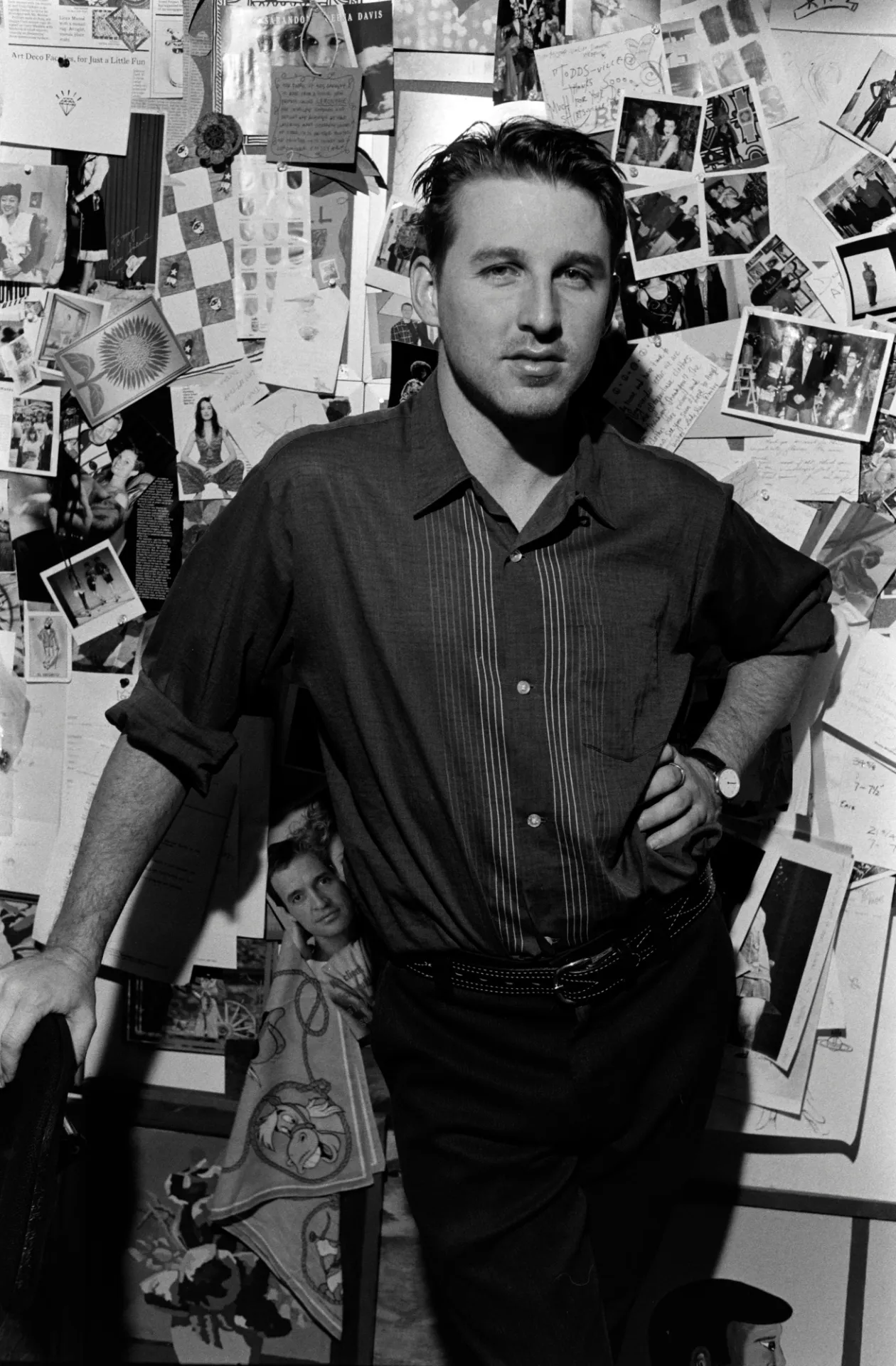
The brand, now a multi-disciplinary design studio, is remembered as an effervescent happening of the New York creative scene in the 1990s. Todd Oldham came into the industry as a multihyphenate designer that loved making things. A straightforward and candid public identity that he paired with a creativity which knew no bounds. From garment making for high end and high street fashion, to children’s books, teaching, furniture design and interior design, along with television gigs, Todd Oldham is on the constant quest for ways to create. Embodying a distinct visual identity and a knack for experimentation, that he is known and loved for to this day.
Nevertheless, McQueen’s sentiment remains worthy of elaboration. What was it about Todd Oldham’s time in the fashion spotlight that prompted Alexander McQueen to proclaim him the standout of the city’s entire fashion industry?
Known as the more commercial of the four capitals, New York City’s fashion landscape of the 1990s could be divided into a few more “teams”. On the one hand, the city was renowned for its minimalist designers such as Calvin Klein and Donna Karan. While the likes of Isaac Mizrahi and Bill Blass among others, catered to a more conservative clientele across the world. On the other hand, however, came a bevy of up-and-coming designers such as Anna Sui, obviously, but also Marc Jacobs and Christian Francis Roth among many others, that offered vibrant clothing, that melded cultural and countercultural references. In 1994, when McQueen made that statement, Seattle’s grunge movement was still influencing the city’s trending labels, specifically the aforementioned. Despite cheeky jabs from some, namely Suzy Menkes, who made “Grunge is Ghastly” pins that she handed out to fellow editors in Milan, the stylistic current uncovered an underground edge that influenced the city’s sartorial landscape and its creatives, but also made them harder to distinguish.
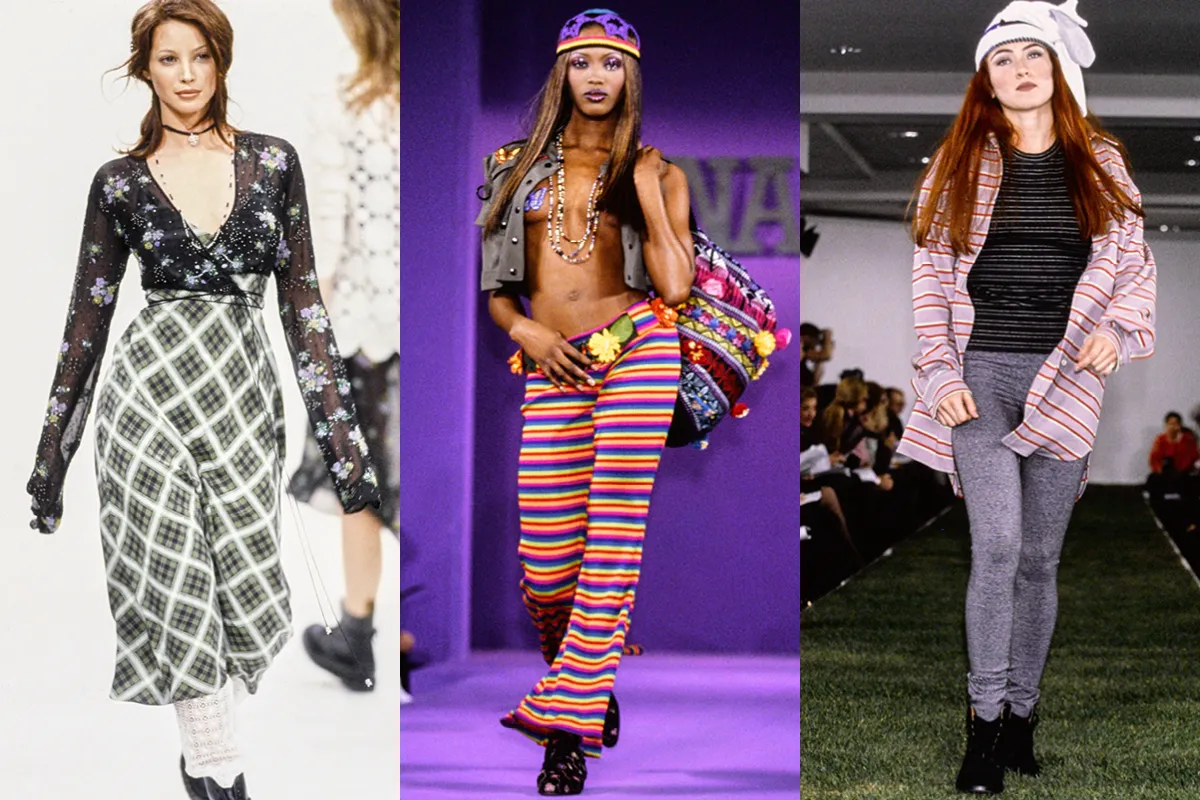
Looks from the Spring 1993 shows of (from left) Perry Ellis, Anna Sui, and Christian Francis Roth - Source: Vogue
It is somewhere amid these archetypes that Dallas based designer Todd Oldham, came in with a rather singular vision. Deemed kitsch by some, Oldham’s work paired eclectic taste and a dash of camp with a deep appreciation for craftsmanship at large. Journalist Christopher Blackmon defined it as “pop surrealism” for Interview Magazine. Even though the “kitsch” label irked the designer, with journalist Mimi Swartz even dubbing him “fashion’s court jester” for the Texas Monthly, it solidified his image in the public eye, which in the industry is a goal that many aspire to achieve. His work went on to grace the closets of some, the television screens of many, and the eyes of the world.
Growing up in a household where TV was traded for a craft table, Todd Oldham developed a knack for creativity early on in his life. Taught by his grandmother, he started learning how to sew at age 7, picking up patterning along the way. Oldham’s rule of thumb has always been to make what he loves, and not to cater to the insatiable fashion system.
Todd Oldham released his brand’s first collection in 1982, with the help of his mother. The operation which immediately began as a design studio quickly became a family affair, involving all members of the Oldham family. The designer borrowed $100 from his parents and purchased a roll of white thermal cotton underwear fabric, and vintage dyes from the 50s and 60s. Thanks to his patterning skills, Oldham started out with an assortment of original oversized pieces in what he describes as “faded and very beautiful colors” from the dyes. Neiman Marcus placed orders right after seeing the pieces and the enterprise took off very quickly, with pieces even being replicated by mass market retailers from the very early days.
When the label was inducted in the New York Fashion Week calendar, it didn’t change the core values of the brand. It did, however, bring a shift in visibility, and allowed for adjacency to better opportunities. Oldham was acutely aware of his brand’s positioning on the market. It wasn’t one that customers would go to for streamlined tailoring, or commercial, almost predictable pieces with highbrow, regurgitated references. A Todd Oldham piece was peculiar: it was inspired by an eclectic mix of cultural artefacts, historical and pop culture references, and was made with intricate techniques and complex textiles.
Between experimentation done at either the studio or directly with manufacturers, nothing came in the way of the design team’s ideas. From taking pictures of leopard fur for the creation of a leopard print, to creating chainmail out of 24 karat bullions threaded with pearls to make a gown, it was just a matter of ingenuity. That same value extended to his fight against animal cruelty as the creator was among the first to take a stance, and forgo the use of animal materials. However, Oldham didn’t want to let go of their aesthetic quality. So whether they were fully hand beading a giraffe print on a silk gown or reaching out to Spring Industries to bring back their Halston era synthetic suede textile, called Ultrasuede, there was a constant quest for creative alternatives. It is worth noting, however, that the conversation around synthetic fibers as replacement for animal materials has become a lot more nuanced over the years. Todd Oldham was just among the first designers to deal with the issue firsthand. He introduced the world to a different way of looking at the matter, paving the way for creators such as Stella McCartney or Collina Strada, in more recent years.
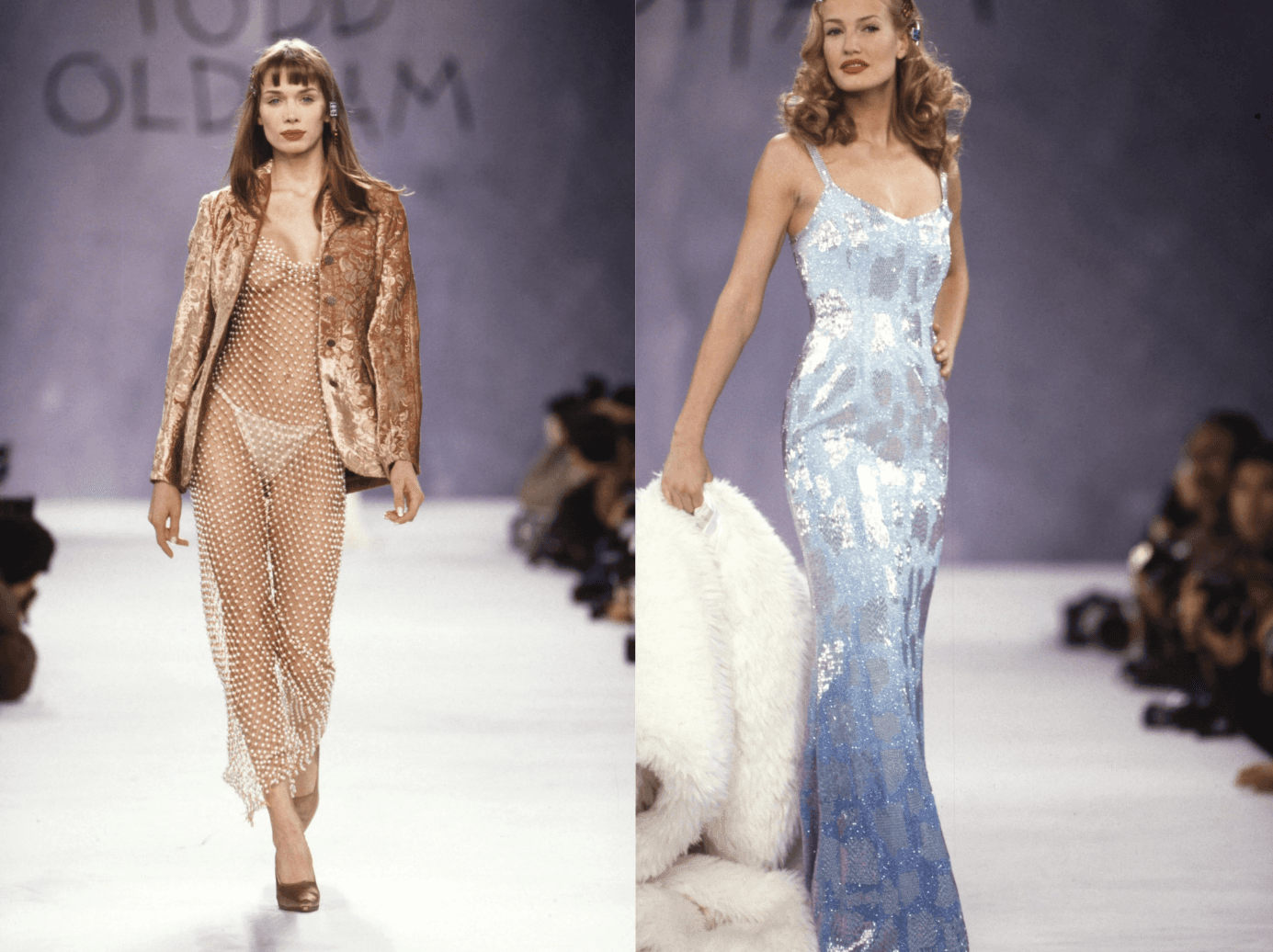
Looks from Todd Oldham’s fall 1994 ready-to-wear runway show - Source: Todd Oldham Design Studio
Beyond innovation, culture played a great part in Oldham’s body of work. Having lived in Iran during his teens, he grew sensitive to the appreciation of cultural wealth. Hence, his work never felt like it was confined to a specific location. Through collaborations with fabric developers in South Korea or Mystic Beading, a 400 year old Indian wedding Sari manufacturer, the house’s collections were informed by traditional crafts, and they were above all, diverse.There was also an intent to make something exceptional out of entities and concepts that were unexpected or looked down upon by the establishment. His Fall 1992 collection, for example, was inspired by an episode of the tv show, The Three Stooges, called “Slippery Silks”, where a group of plumbers are made to put on a fashion show. This collection went on to earn him the CFDA’s Perry Ellis prize for New Fashion Talent. It also brought interior design into a broader conversation around garments.
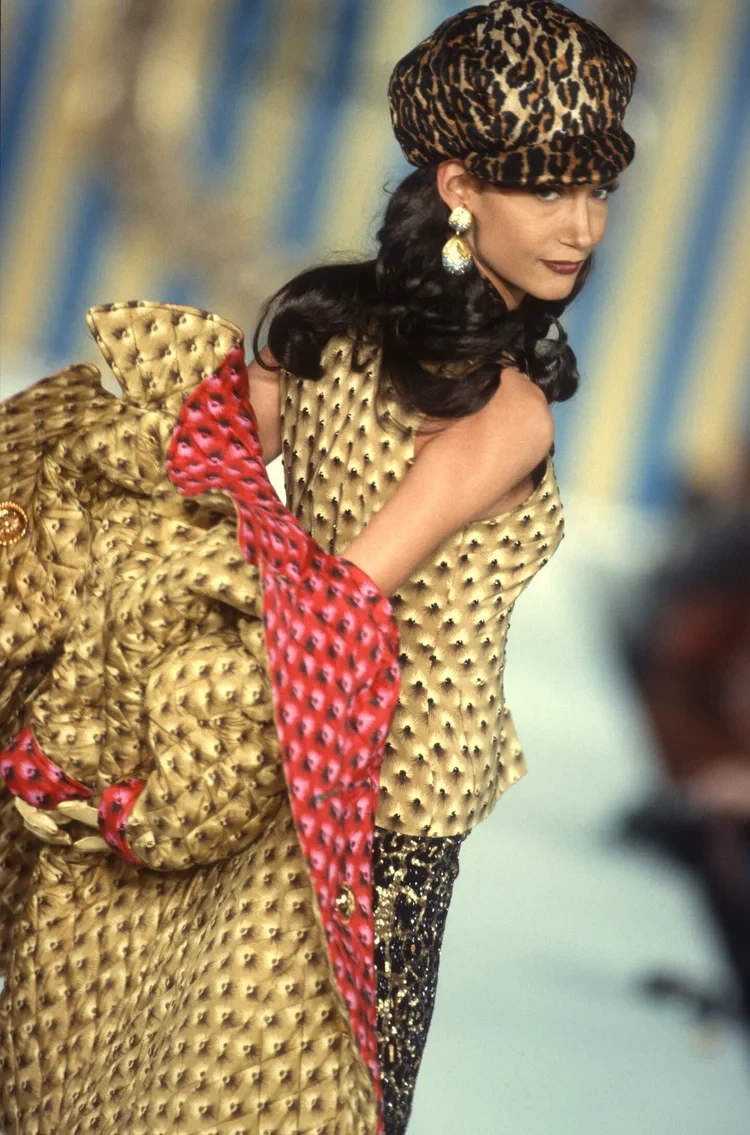
Marpessa Hennink walking the runway at Todd Oldham’s fall 1992 ready-to-wear runway show - Source: Todd Oldham Design Studio
Notwithstanding, more subtle details also played a big part in his work. Whether it was about working with a Tie Dye professional to create a snowflake pattern on gowns, to collaging pictures from cake books to create a pattern for ensembles, the playful prints were there to compliment the funky patterning work. In comparison to the patterns of other designer label’s, Todd’s were mainly inspired by something he grew up with, mall brand catalogs such as Sears. Though high fashion as inspiration came into the fold overtime, the standardized silhouettes and normative quality of the mass market retailers’ clothing revealed easy to subvert and make something new out of. Todd Oldham still describes the brand as a “fashion anomaly”. It had enough proximity with the fashion system to be a part of the action but stayed far enough from it to avoid unwanted creative compromises.
No matter the complexity of its nature however, Todd Oldham’s work wasn’t exclusionary in any way. Though his mainline pieces could reach sizeable prices, he made his vision accessible to everyone through different channels. Whether it be through his diffusion line, Todd Oldham Times Seven, or by showing the world how to reupholster a couch or upcycle thrifted clothing in his segment “Todd’s Time” for the famed House of Style show on MTV. The intention of showcasing intricate and considered productions at every price point was omnipresent. In a way, Todd Oldham revitalized what is known today as DIY, by imparting his acquired knowledge to the world.
Oldham’s craftsmanship and inventiveness also came with a prominent spot in New York’s cultural scene. The brand’s fashion shows were highly anticipated by everyone in attendance, along with those who wished to be. With no previews ahead, nor sample sales, every runway presentation had guests on the edge of their seats. The soundtracks had some of the most innovative dance music produced by New York based djs at the time such as Junior Vasquez and David Morales. RuPaul’s hit song “Supermodel” even had its debut at Todd Oldham’s Spring 1993 show. It was as Shalom Harlow would describe it, “a New York scene”.
Along with the invigorating set up, these presentations had something that houses like Thierry Mugler and Jean Paul Gaultier mastered, personality casting. Made up of top models of the time, such as Kristen McMennamy and Veronica Webb, the shows were punctuated by club kids like Billie Beyond and the occasional celebrities such as Queen Latifah. The brand was at the pinnacle of cultural relevance within the city, and whoever was apart of the group of “friends of the house”, aligned with its eclectic style: Susan Sarandon, Lady Miss Kier, Amy Sedaris, andParker Posey, along with many more, all represented different aspects of the brand, different customers. It was the highly cultured and fresh perspective on glamour and dressing up that still makes these celebrities, and therefore the brand, so fascinating nearly three decades later. This community spirit extended not only to the family business dynamic, but also the creative collaborations with contributors such as Michael Economy, illustrator for the band Deee-Lite, or storied New York City institutions such as James Veloria, The MET, or The RISD (Rhode Island School of Design Museum), where a retrospective exhibition was held in honour of the designer’s run during the 1990s. Presley Oldham worked for their uncle when they were little and is now a promising talent of New York City’s creative scene with their jewelry line which, just like their uncle, also granted them a CFDA nomination.
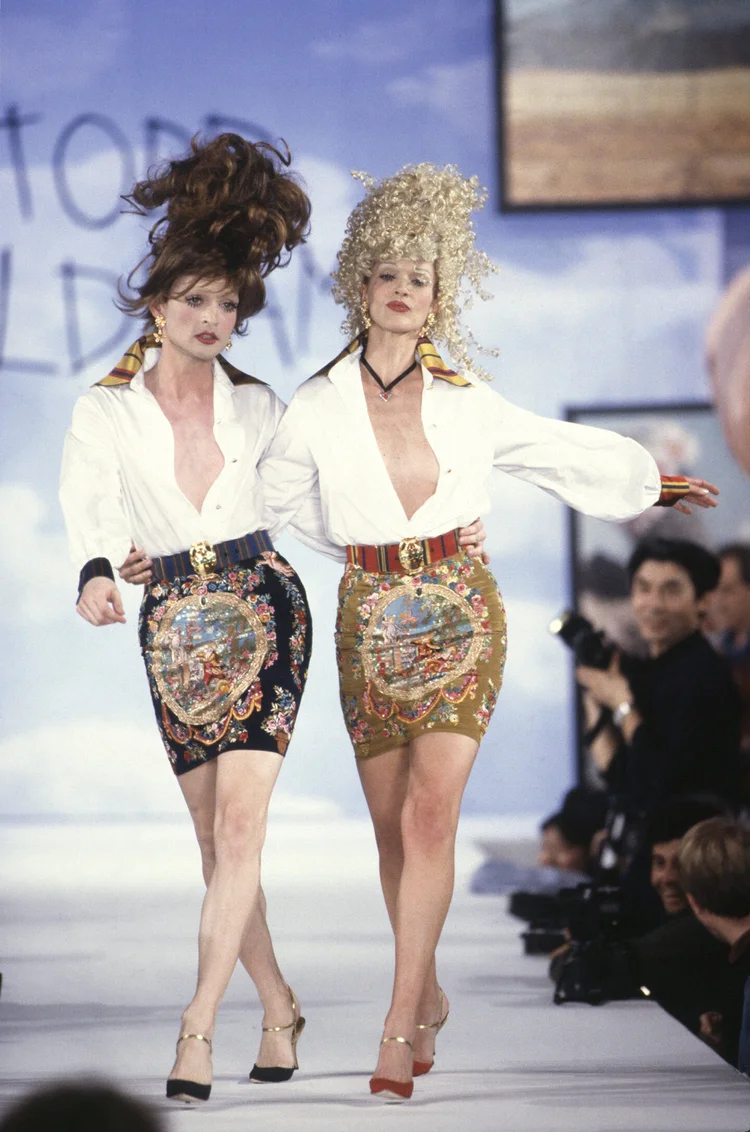
Billie Beyond and Diane DeWitt walking the runway at Todd Oldham’s spring 1993 ready-to-wear runway show - Source: Todd Oldham Design Studio
In the end, Alexander McQueen did have a point. At that point in time, New York’s fashion scene was indeed made up of, if not 200, many Anna Sui adjacent brands. No one really approached culture quite like Todd Oldham. The latter went against the tide and presented New York City’s fashion sphere with what it was missing at the time, ornate humourism. In many ways, the radical nature and the sophistication of Oldham’s work aligned with that of McQueen. Both visionaries were among the few successful designers with a working-class upbringing. Thanks in large part to it, both came into the industry with a solution-driven mindset. Having used methods such as mud dyeing for his graduation collection, McQueen’s creative processes and motivation to create well designed and experimental clothing had many similarities with Oldham’s. Not only were they inspired and influenced by their environment and their own lived experiences, they also were among the first creators to look to more mundane parts of culture for inspiration, albeit in very different ways. They both made a vivid impression when they first came on the scene. Their body of work substantially shifted the way people, on a broader level, approach the consumption of fashion and the incorporation of it in their daily lives to this day.
Doc/34 all rights reserved, sponsored by IFM.
" height="65.65946764590899px" id="biO_icj08" transform="translate(0 1.371)" width="59.174572953517554px"/><path d="M 63.167 33.692 C 63.167 54.377 50.565 68.088 31.544 68.088 C 12.524 68.088 0 54.69 0 33.927 C 0 13.163 12.371 0 31.626 0 C 50.882 0 63.17 13.163 63.17 33.692 Z M 46.89 33.848 C 46.89 21.155 41.097 13.477 31.626 13.477 C 22.155 13.477 16.206 21.234 16.206 33.848 C 16.206 46.463 22.077 54.533 31.626 54.533 C 41.176 54.533 46.89 46.698 46.89 33.848 Z" fill="rgb(0, 0, 0)" height="68.08839784893921px" id="A8_8V8D77" transform="translate(58.705 0.196)" width="63.17042207703656px"/><path d="M 43.755 24.133 C 42.268 17.003 38.119 13.477 31.388 13.477 C 21.838 13.477 16.281 20.998 16.281 33.927 C 16.281 46.855 22.073 54.455 31.779 54.455 C 36.084 54.455 39.763 52.653 42.033 49.519 C 43.363 47.638 43.911 46.071 44.381 42.781 L 60.662 45.209 C 59.175 51.869 57.453 55.709 54.165 59.548 C 49.312 65.111 41.72 68.088 32.249 68.088 C 22.778 68.088 14.637 65.111 9.08 59.47 C 3.287 53.593 0 44.426 0 33.927 C 0 23.427 3.287 14.26 9.471 8.149 C 14.872 2.899 22.778 0 31.935 0 C 42.033 0 49.938 3.448 55.026 10.264 C 57.531 13.477 58.861 16.376 59.879 20.998 Z M 100.346 1.41 L 72.246 77.804 L 58.235 77.804 L 86.414 1.41 Z" fill="rgb(0, 0, 0)" height="77.80411839929134px" id="v1AksvdEb" transform="translate(121.519 0.196)" width="100.34629996240147px"/><path d="M 16.594 46.933 C 17.064 49.519 17.533 50.616 18.786 51.948 C 20.899 54.142 24.03 55.317 27.787 55.317 C 33.892 55.317 37.728 52.261 37.728 47.482 C 37.728 44.269 36.162 41.762 33.501 40.743 C 31.701 40.117 29.274 39.725 26.222 39.725 C 23.169 39.725 19.647 39.881 16.594 40.195 L 16.594 26.718 C 19.255 27.032 21.838 27.188 24.891 27.188 C 32.327 27.188 36.006 24.681 36.006 19.666 C 36.006 15.435 33.031 13.007 27.865 13.007 C 22.308 13.007 19.49 15.2 18.316 20.215 L 1.409 17.786 C 2.896 12.928 4.148 10.578 6.653 7.835 C 11.428 2.664 18.629 0 28.178 0 C 36.71 0 43.755 2.351 48.216 6.66 C 51.112 9.559 52.6 13.32 52.6 17.786 C 52.6 26.091 48.138 31.263 39.137 33.378 C 43.911 34.083 46.494 35.18 49.234 37.531 C 52.521 40.508 54.4 44.583 54.4 49.127 C 54.4 53.123 53.304 56.806 51.269 59.548 C 49.547 61.899 46.807 64.092 43.911 65.424 C 39.841 67.305 33.501 68.48 27.63 68.48 C 20.586 68.48 13.541 66.835 9.393 64.092 C 5.792 61.742 3.053 58.294 1.331 53.985 C 0.861 52.888 0.548 51.869 0 49.832 Z" fill="rgb(19, 136, 8)" height="68.48016075605614px" id="UrmKxPWFQ" transform="translate(219.752 0)" width="54.399905030019454px"/><path d="M 0 37.844 C 2.348 35.233 4.853 32.36 7.514 29.226 L 24.5 9.324 C 28.257 5.015 29.744 3.056 31.779 0 L 47.825 0 C 47.355 4.623 47.199 7.757 47.199 13.007 L 47.199 38.471 L 49.469 38.471 C 51.895 38.471 54.478 38.236 57.218 37.844 L 57.218 52.104 C 54.87 51.791 51.973 51.634 49.547 51.634 L 47.199 51.634 L 47.199 55.552 C 47.199 59.94 47.355 62.212 47.825 65.189 L 31.701 65.189 C 32.092 62.525 32.327 59.235 32.327 55.395 L 32.327 51.556 L 10.176 51.556 C 5.088 51.556 2.896 51.634 0 51.869 Z M 32.405 29.539 C 32.405 26.013 32.562 21.704 32.875 18.256 C 31.309 20.45 30.135 22.017 28.022 24.681 L 16.594 38.628 L 32.405 38.628 Z" fill="rgb(19, 136, 8)" height="65.18935212489366px" id="nz3MAn0g5" transform="translate(272.782 1.567)" width="57.21774185674667px"/></g></svg>)