Reflections
How Did the Japanese Concept of Ma (間) Influence Avant-garde Fashion in the 1980s and 1990s, Particularly in the Work of Japanese Designers in Paris?
Written by Tijs Florian Vink and Edited by Leyla Boudieb
In the work of Japanese designers in Paris, particularly Rei Kawakubo and Yohji Yamamoto, garments no longer functioned to define or display the body. Instead, volume, distance, and movement allowed meaning to emerge through the space between fabric and wearer, challenging established Western fashion conventions. In this piece, we shall further explore how the Japanese concept of Ma (間) has played a role in this movement.
Ma (間)
Historically, Western fashion has functioned as a system that organises and regulates the appearance of the human body, preferring for it to be socially legible rather than trying to obscure it. Through practices such as tailoring, corsetry, and structured silhouettes, Western fashion has worked to discipline the body according to culturally specific ideals of form, proportion, and identity, reinforcing dominant aesthetic norms within European fashion traditions (Evans 2003).
In contrast to this Western approach, Japanese aesthetic traditions have a fundamentally different understanding of space and form, in which meaning is not produced solely through visible structure, but through the relationship and space between elements. Central to this is the concept of ma (間), which is often translated as “interval” or “pause,” referring to the space or time between forms, generating meaning through absence. Rather than signifying emptiness, ma is understood as an active and dynamic space, shaping perception by allowing for openness and potential (Prusinski 2012).
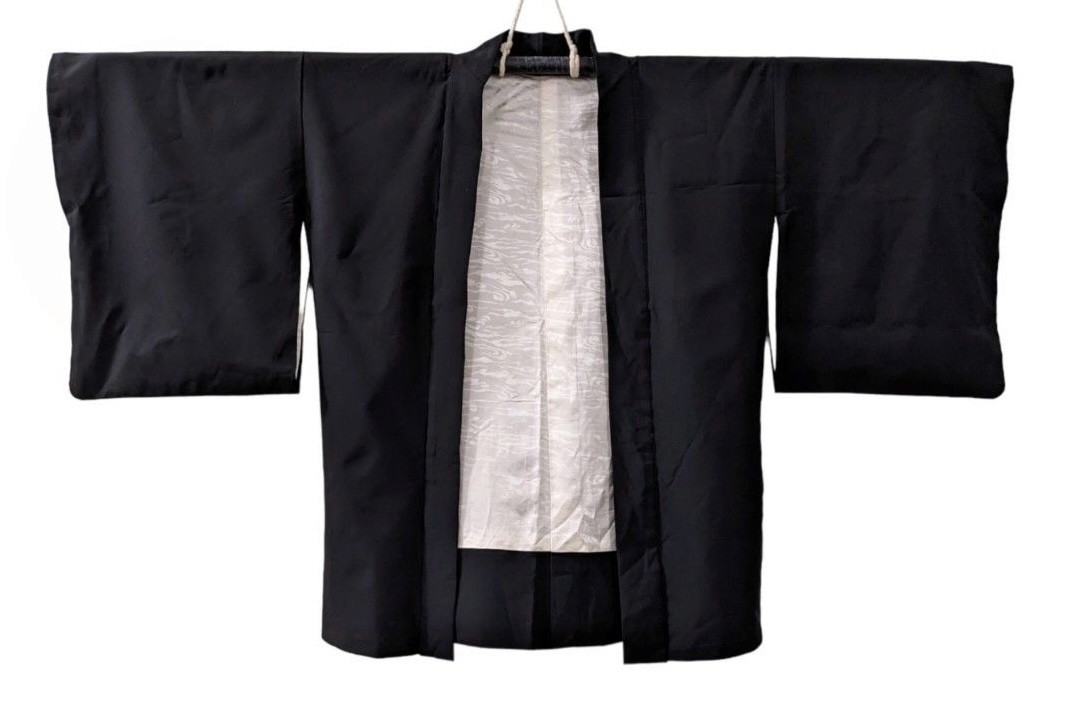
The concept of ma can also be observed in Japanese fashion. The kimono, a traditional form of Japanese dress, is an assemblage of rectangular pieces of fabric, and unless worn, it lies completely flat. This means that the body itself is what gives the garment its shape, which as a dressmaking ethos is the diametric opposite to Western tailoring, which has historically been concerned with shaping the body. The superfluous space which is created between the body and the kimono can also be considered ma — a rich space that possesses incalculable energy (Fukai et al. 2010).
Kimono laid flat (source unknown)
Building on this understanding of ma, this essay examines how Japanese avant-garde designers of the 1980s and 1990s translated this aesthetic principle into fashion, challenging dominant Western conceptions of the body, silhouette, and form. It asks how ma functioned as a conceptual framework through which these designers redefined the relationship between garment, body, and space. Through visual and theoretical analysis of key designers and collections, this essay argues that ma enabled a fundamentally different approach to fashion, one in which space and distance became a central idea.
The case of Rei Kawakubo
Rei Kawakubo was the first Japanese designer to bring her brand, Comme des Garçons, to Paris. After opening a retail space in the city in 1969, her designs did not appear on the Paris runway until 1981. When they did, they immediately stood apart from the dominant fashion language of the time. Although little runway footage from Comme des Garçons’ early Paris years survives, a clear impression of this period can be found in the publications Comme des Garçons 1975–1982 and Comme des Garçons 1981–1986. The images in these books show models wearing garments defined by unusual volume and irregular form. Dresses swell outward, jackets drape widely across the body, and trousers balloon away from the legs. The body beneath the clothing is hard to make out; its outline is softened, distorted, or partially concealed by fabric. Rather than following the body’s shape, the garments appear to hover around it, creating a visible distance between body and dress.
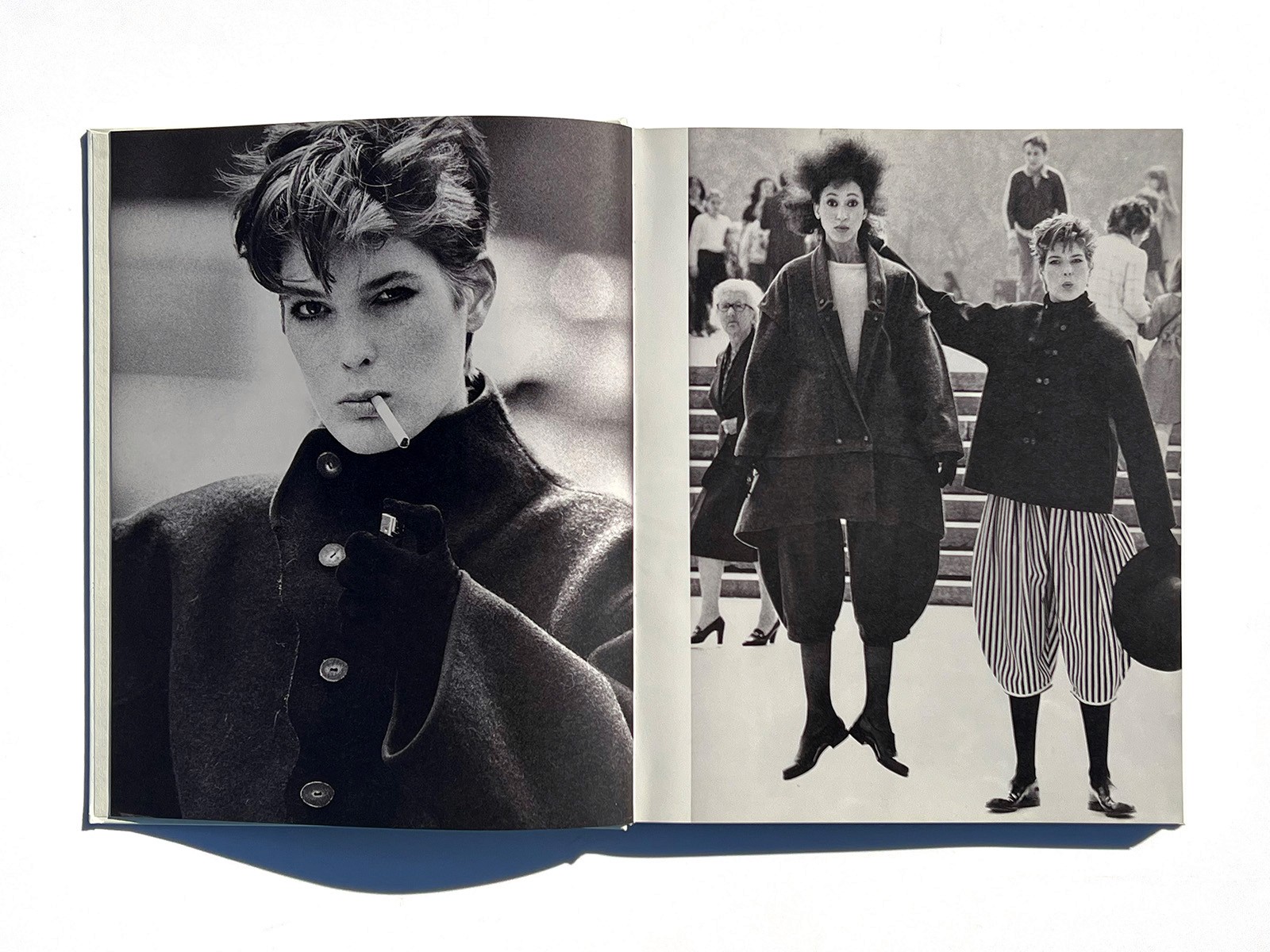
CDG 1981 (from 'COMME DES GARÇONS 1981-1986' by Peter Lindbergh & Rei Kawakubo)
Kawakubo has never explicitly described her work in terms of ma, yet these early designs consistently display the space between garment and wearer. The clothing neither reveals nor clearly defines the body, but instead produces zones of ambiguity where form shifts into volume. Meaning emerges not from structure or fit, but from the tension between presence and absence, between what can be seen and what remains hidden. Read in this way, Kawakubo’s work quietly disrupts Western expectations of fashion by allowing space, rather than silhouette, to shape how the body is perceived.
The case of Yohji Yamamoto
In the same year Kawakubo presented her first collection at Paris Fashion Week, another talented Japanese designer had just opened up shop in the Paris neighbourhood Le Marais: Yohji Yamamoto. After having conquered the hearts of the Japanese, he felt that it was time to try something new and opted to show his work in Paris.
As with Comme des Garçons, there is little footage of Yamamoto’s earlier Paris shows. There is, however, an image of him standing amongst his models, taking the stage after the show has ended. He looks towards the ground shyly, dressed up in his signature black suit. The models surrounding him are dressed in long, flowy coats and skirts, which naturally drape around their bodies without revealing too much shape. Rather than clinging to or sculpting the body, the garments exist at a measured distance from it, creating movement that shift as the models do.
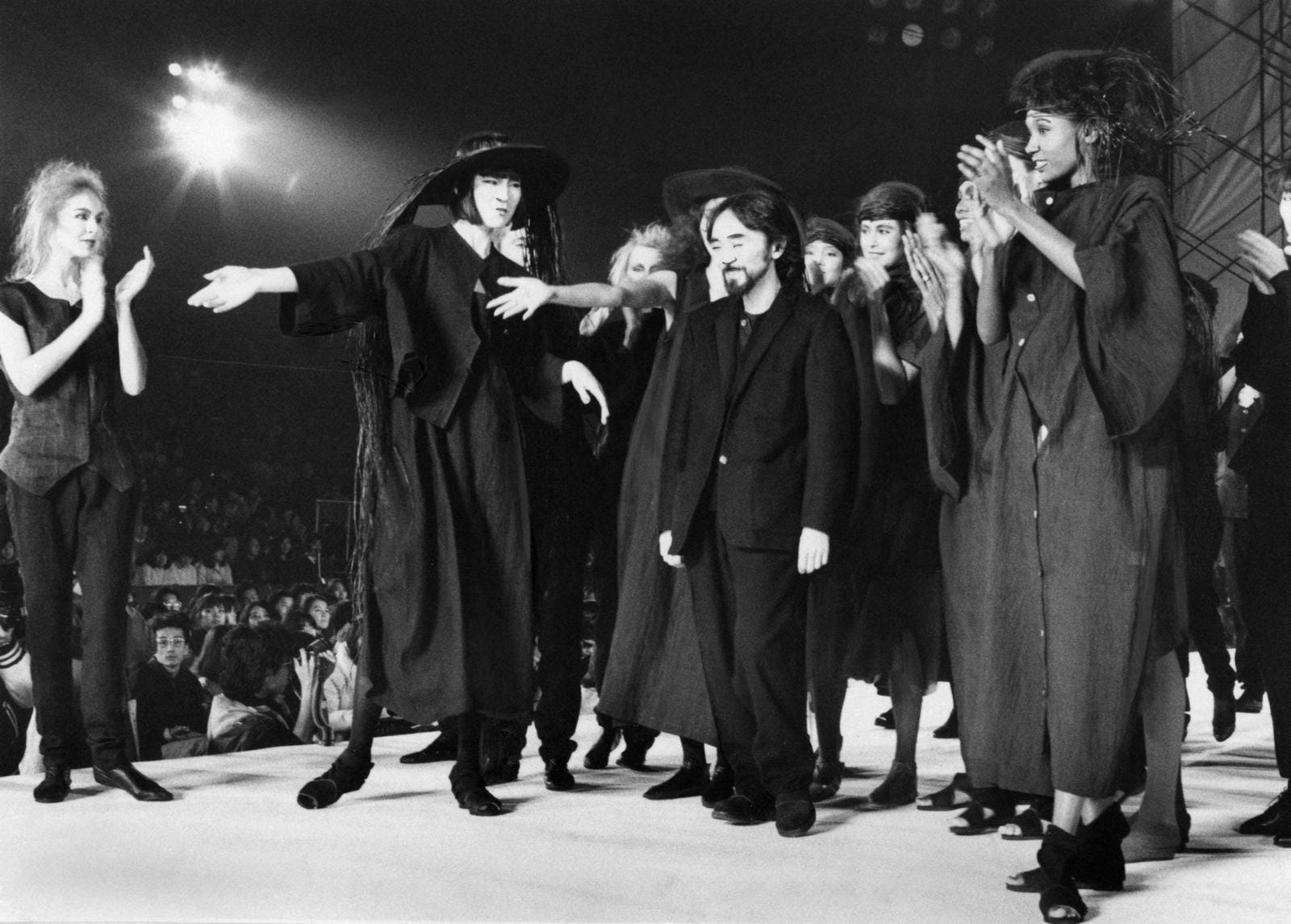
YOHJI 1981 (after runway show, photographer unknown)
The spatial looseness of these fabrics and silhouettes creates the interval between body and clothing, directing attention not to the human form, but to the space and energy that surround it. In this sense, Yamamoto’s designs can also be read through the lens of ma: meaning emerges not from overt structure or definition, but from the quiet tension between presence and absence.
Ma in the west — The case of Ann Demeulemeester
The year 1981 is not only significant for the arrival of Japanese designers in Paris; it also marks the graduation of a small group of designers from the Royal Academy of Fine Arts Antwerp, later known as the Antwerp Six. Among them was Ann Demeulemeester, a young designer whose work already revealed a strong sensitivity to layering, draping, and proportion.
Rare early runway images, found in a publication documenting Demeulemeester’s complete body of work, reveal a clear and consistent visual language. Models are dressed in long, dark garments that droop loosely from the shoulders and extend toward the ground. Coats and dresses are layered rather than fitted, with fabric folding and shifting as the models walk. The waist, hips, and chest are largely obscured — the garments dominate the silhouette.
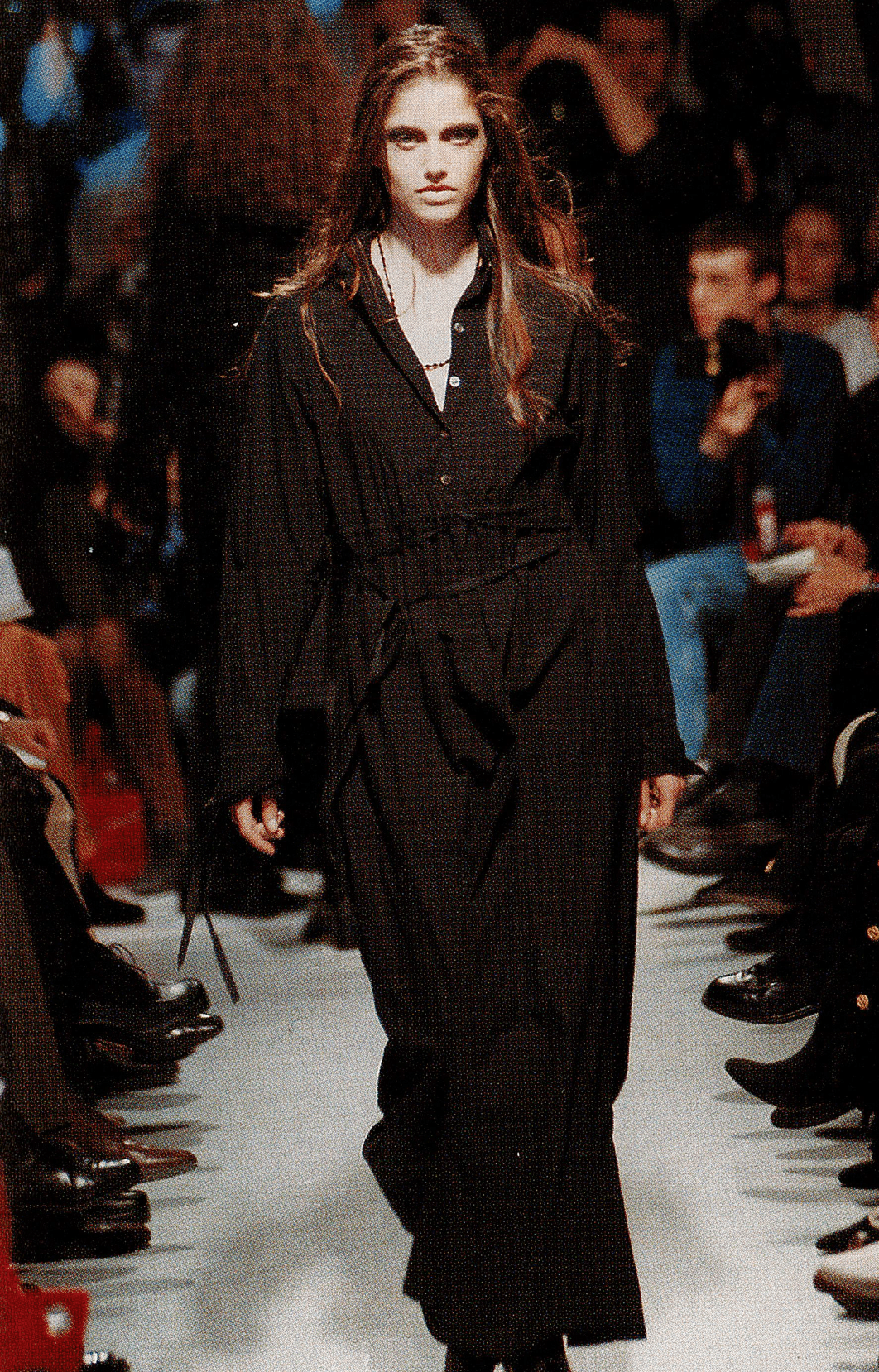 ANN D 199X 1 (from 'ANN DEMEULEMEESTER by Patti Smith & Ann Demeulemeester) | 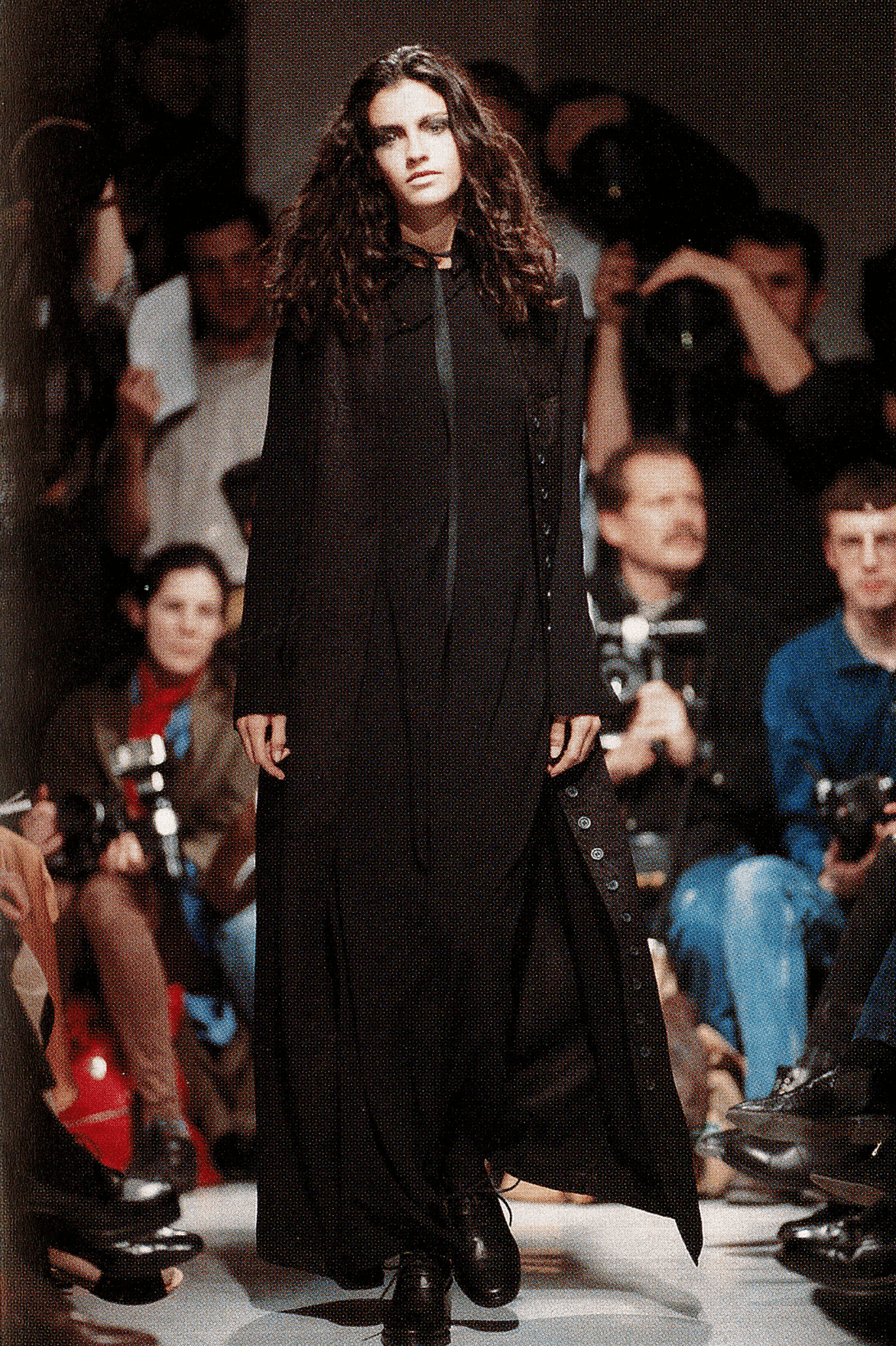 ANN D 199X 2 (from 'ANN DEMEULEMEESTER' by Patti Smith & Ann Demeulemeester) |
Instead of shaping the body, the clothing creates weight and volume around it, producing a sense of distance between skin and fabric.
Having examined how ma operates in the work of Kawakubo and Yamamoto, its presence in Demeulemeester’s designs takes on a different character. As a Western designer, she does not draw on ma as a culturally embedded concept, but adapts its logic through her own design language. The space between body and garment functions as an active element: fabric falls away and meaning emerges through restraint rather than emphasis. In this way, Demeulemeester’s work shows how the logic of ma can be translated into a Western context, offering an alternative to fashion traditions that prioritise bodily clarity and control.
Conclusion
When looking at these collections, we can see how the Japanese concept of ma played a significant role in shaping avant-garde fashion in the 1980s and 1990s by introducing a different way of thinking about space, form, and the body. In the work of Japanese designers in Paris, particularly Rei Kawakubo and Yohji Yamamoto, garments no longer functioned to define or display the body. Instead, volume, distance, and movement allowed meaning to emerge through the space between fabric and wearer, challenging established Western fashion conventions.
The influence of ma extended beyond its Japanese context, as seen in the work of Ann Demeulemeester. Through layering, draping, and bodily obscuration, her designs adopted a similar sensitivity to space, showcasing the logic of ma within a Western fashion system. Together, these cases demonstrate how ma functioned not as a visual style, but as a way of thinking: one that reshaped avant-garde fashion and body norms by placing space and absence at its centre.
Doc/34 all rights reserved, sponsored by IFM.
" height="65.65946764590899px" id="biO_icj08" transform="translate(0 1.371)" width="59.174572953517554px"/><path d="M 63.167 33.692 C 63.167 54.377 50.565 68.088 31.544 68.088 C 12.524 68.088 0 54.69 0 33.927 C 0 13.163 12.371 0 31.626 0 C 50.882 0 63.17 13.163 63.17 33.692 Z M 46.89 33.848 C 46.89 21.155 41.097 13.477 31.626 13.477 C 22.155 13.477 16.206 21.234 16.206 33.848 C 16.206 46.463 22.077 54.533 31.626 54.533 C 41.176 54.533 46.89 46.698 46.89 33.848 Z" fill="rgb(0, 0, 0)" height="68.08839784893921px" id="A8_8V8D77" transform="translate(58.705 0.196)" width="63.17042207703656px"/><path d="M 43.755 24.133 C 42.268 17.003 38.119 13.477 31.388 13.477 C 21.838 13.477 16.281 20.998 16.281 33.927 C 16.281 46.855 22.073 54.455 31.779 54.455 C 36.084 54.455 39.763 52.653 42.033 49.519 C 43.363 47.638 43.911 46.071 44.381 42.781 L 60.662 45.209 C 59.175 51.869 57.453 55.709 54.165 59.548 C 49.312 65.111 41.72 68.088 32.249 68.088 C 22.778 68.088 14.637 65.111 9.08 59.47 C 3.287 53.593 0 44.426 0 33.927 C 0 23.427 3.287 14.26 9.471 8.149 C 14.872 2.899 22.778 0 31.935 0 C 42.033 0 49.938 3.448 55.026 10.264 C 57.531 13.477 58.861 16.376 59.879 20.998 Z M 100.346 1.41 L 72.246 77.804 L 58.235 77.804 L 86.414 1.41 Z" fill="rgb(0, 0, 0)" height="77.80411839929134px" id="v1AksvdEb" transform="translate(121.519 0.196)" width="100.34629996240147px"/><path d="M 16.594 46.933 C 17.064 49.519 17.533 50.616 18.786 51.948 C 20.899 54.142 24.03 55.317 27.787 55.317 C 33.892 55.317 37.728 52.261 37.728 47.482 C 37.728 44.269 36.162 41.762 33.501 40.743 C 31.701 40.117 29.274 39.725 26.222 39.725 C 23.169 39.725 19.647 39.881 16.594 40.195 L 16.594 26.718 C 19.255 27.032 21.838 27.188 24.891 27.188 C 32.327 27.188 36.006 24.681 36.006 19.666 C 36.006 15.435 33.031 13.007 27.865 13.007 C 22.308 13.007 19.49 15.2 18.316 20.215 L 1.409 17.786 C 2.896 12.928 4.148 10.578 6.653 7.835 C 11.428 2.664 18.629 0 28.178 0 C 36.71 0 43.755 2.351 48.216 6.66 C 51.112 9.559 52.6 13.32 52.6 17.786 C 52.6 26.091 48.138 31.263 39.137 33.378 C 43.911 34.083 46.494 35.18 49.234 37.531 C 52.521 40.508 54.4 44.583 54.4 49.127 C 54.4 53.123 53.304 56.806 51.269 59.548 C 49.547 61.899 46.807 64.092 43.911 65.424 C 39.841 67.305 33.501 68.48 27.63 68.48 C 20.586 68.48 13.541 66.835 9.393 64.092 C 5.792 61.742 3.053 58.294 1.331 53.985 C 0.861 52.888 0.548 51.869 0 49.832 Z" fill="rgb(19, 136, 8)" height="68.48016075605614px" id="UrmKxPWFQ" transform="translate(219.752 0)" width="54.399905030019454px"/><path d="M 0 37.844 C 2.348 35.233 4.853 32.36 7.514 29.226 L 24.5 9.324 C 28.257 5.015 29.744 3.056 31.779 0 L 47.825 0 C 47.355 4.623 47.199 7.757 47.199 13.007 L 47.199 38.471 L 49.469 38.471 C 51.895 38.471 54.478 38.236 57.218 37.844 L 57.218 52.104 C 54.87 51.791 51.973 51.634 49.547 51.634 L 47.199 51.634 L 47.199 55.552 C 47.199 59.94 47.355 62.212 47.825 65.189 L 31.701 65.189 C 32.092 62.525 32.327 59.235 32.327 55.395 L 32.327 51.556 L 10.176 51.556 C 5.088 51.556 2.896 51.634 0 51.869 Z M 32.405 29.539 C 32.405 26.013 32.562 21.704 32.875 18.256 C 31.309 20.45 30.135 22.017 28.022 24.681 L 16.594 38.628 L 32.405 38.628 Z" fill="rgb(19, 136, 8)" height="65.18935212489366px" id="nz3MAn0g5" transform="translate(272.782 1.567)" width="57.21774185674667px"/></g></svg>)