References
Is art helplessly subordinate to politics? A discussion about the artist Joseph Beuys
By Niclas Kauermann
In times of political crisis, art often loses visibility and influence. When one considers the influence that politics exert on art through financial means, the question arises as to whether art can truly function as an expression of opposition or whether it is merely subordinate to politics. The work of German artist Joseph Beuys, which oscillates between provocative art and progressive politics, perfectly illustrates this tension.
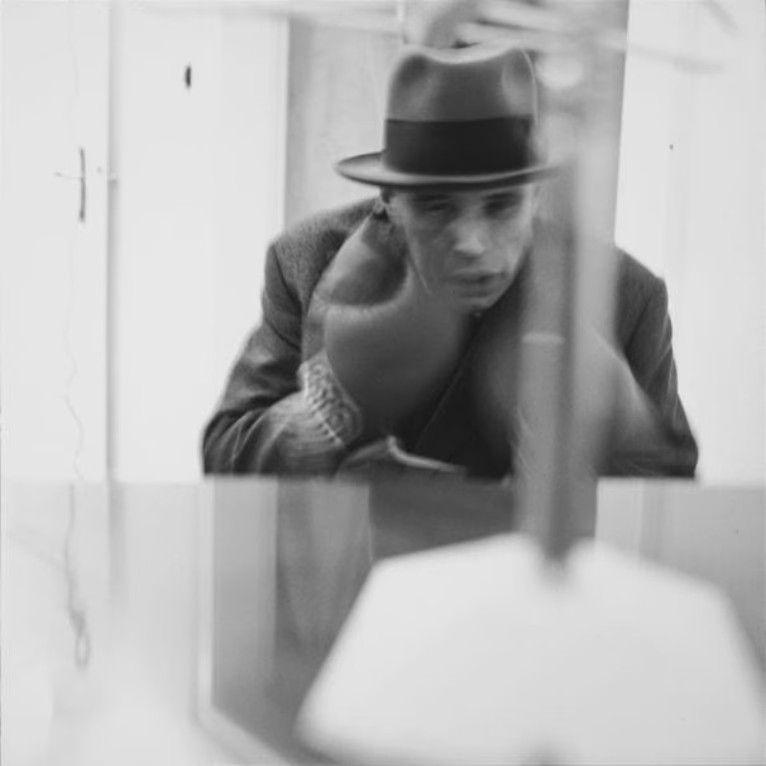
This year's edition of the Berlinale film festival began with controversy. During the opening press conference, a journalist asked the jury for their statement on the Gaza conflict. After a long moment of hesitation, Ewa Puszczyńska (producer of “The Zone of Interest”) responded with a rambling statement that ‘films are not political’. She added that the question was ‘a little bit unfair’ because ‘she cannot be responsible for what [the viewers] decision would be.’
Wim Wenders, the acclaimed director of films such as ‘Wings of Desire’ and also a member of the jury, agreed with this stance, stating: ‘We have to stay out of politics.’ The Film critic Wolfgang Schmitt saw in these responses ‘a great fear of speaking about certain political debates because of the threat of losing funding [from politicians].’ International filmmakers such as Tilda Swinton also criticised the Berlinale's ‘institutional silence’.
It almost seems as if art is helplessly exposed to politics and forced to submit to it. Meanwhile, on the other side of the Atlantic, Donald Trump's war on culture in the USA is progressing almost smoothly: institutions are being renamed, exhibition texts revised, or entire exhibitions restructured. And if they resist, their funding is simply withdrawn.
In view of this upheaval, it is understandable that those involved in the cultural industry can quickly fall into an existential crisis. One begins to question how much artistic activity can actually contribute to changing social problems. How much value and resilience do cultural goods really have? Are they merely a luxurious leisure activity, or can cultural production be a form of political opposition after all?
One answer to this question may be found in the work of German artist Joseph Beuys. Beuys not only reflected his thoughts on politics in his art, but also actively participated in it. He exemplifies the fusion of art and politics – as a creator of artworks that can significantly influence political discourse. As Andy Warhol once said after meeting Beuys: ‘I like the politics of Beuys. He should come to the US and be politically active there. That would be great... he should be president.’
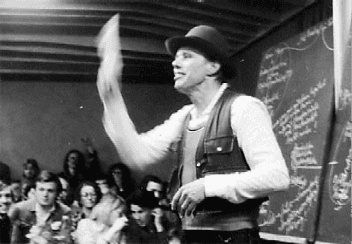
Joseph Beuys: Lecture Every Human Being an Artist, 1978 - Source: From Rainer Rappmann www.fiu-verlag.com - www.fiu-verlag.com, CC BY-SA 3.0, https://commons.wikimedia.org/w/index.php?curid=1554568
Since his birth, Joseph Beuys' life had been strongly influenced by politics. Born in 1921 in a small village in West Germany, he quickly joined the Hitler Youth with the rise of the National Socialists. The young Beuys initially wanted to become a doctor, but as a teenager he quickly felt at home in the fascist environment. So much so that in 1941 he volunteered for the German Air Force. Despite – or perhaps because of – the terrible environment, he later found his way to art here. He began to draw, mostly sketches of his immediate surroundings, and met a zoologist in the Wehrmacht who sparked his interest in sociology.
But the terror continued to rage around him. By 1944, Hitler's glory days were long gone. In the west, the Americans and British were preparing to land in Normandy; in North Africa, the Germans had been driven out by the British; and in the east, Stalin was advancing closer to Berlin with each passing day. During this time, Beuys was sent to the eastern front to push back the Red Army. In Crimea, he was deployed as a co-pilot to carry out air strikes in line with Hitler's war plans.
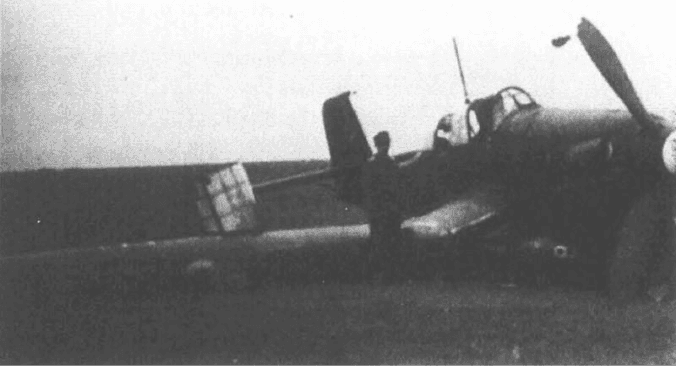
Joseph Beuys in front of his crashed aeroplane, 1943
Yet, during a flight on 16 March 1944, his plane crashed. The pilot did not survive the crash, but Beuys did. Years later, Beuys reported that after the crash, he was found and rescued by the Tatars, the indigenous people of Crimea. In a felt tent, he was reportedly rubbed with fat and fed honey. These three materials would later accompany him throughout his career and reappear in his art. Throughout his life, the story was repeatedly questioned as mere legend. Whether true or not, Beuys used it to mark his turning point away from National Socialism and toward art.
Back in a Germany devastated by the Second World War, Joseph Beuys decided to pursue an artistic career at the Düsseldorf Art Academy. He enrolled in the sculpture class and worked as a sculptor after graduating. His works from this period often consisted of gravestones or religious sculptures. This art, which was partly merely aesthetic, plunged Beuys into the familiar crisis of meaning: he questioned the social influence of his artistic work and finally decided to teach as a professor at the academy himself.
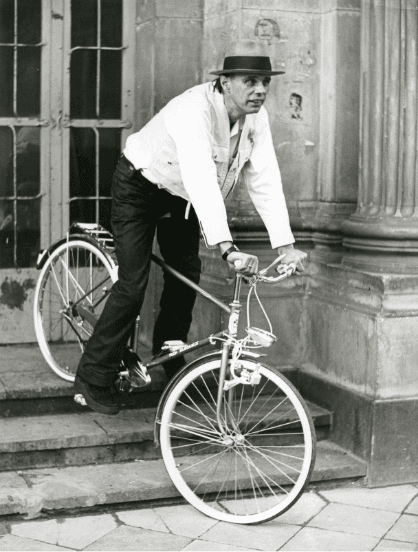
Joseph Beuys at the entrance to the Düsseldorf Art Academy – Source: From Hans Lachmann / Archiv der Evangelischen Kirche im Rheinland from Düsseldorf/ Boppard, Deutschland - Josph Beuys - mit Fahrrad auf den Stufen der Kunstakademie Düsseldorf, CC BY-SA 2.0, https://commons.wikimedia.org/w/index.php?curid=50083060
Provocation became an integral part of this work. During one of his performances, in which he played on a piano filled with water, a member of the audience felt so offended by the artist's actions that he punched Beuys in the face. In another performance in New York, the artist spent several days locked in a room with a coyote (symbolising the indigenous inhabitants of America), with the animal's toilet consisting of US political newspapers. Previously, in one of his performances, Beuys demanded in his invitation card that the East German Wall should be ‘raised by 5 cm’. At that time, the wall was a direct symbol of the tense Cold War. It divided Germany into two independent states that were in an immediate war with each other.
Beuys' demands for a wall five centimetres higher was thus met with strong indignation. His appeal even reached the office of the then state minister, who was so angered by the artist's provocation that he demanded a statement from him. Beuys had succeeded for the first time: through provocation in his art, he caused a political stir and gained a platform for his ideas. In his following statement, he subsequently spoke out against all prevailing walls – those between men and women, rich and poor, and also between East and West. He used the stage to publicise his own ideology. Beuys had achieved his goal of transforming art into politics: art that not only talks about politics, but actively shapes it through provocation.
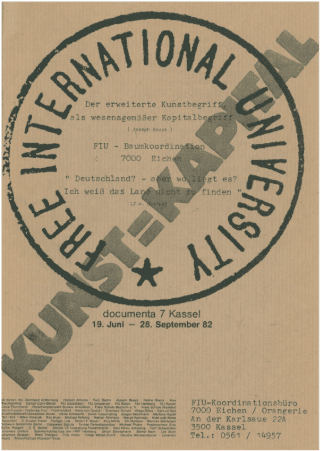
The cover page of the programme of events for Beuys's ‘Free International University’ at documenta 7 - Source: From Pressebüro der Documenta GmbH Klaus Becker / Photo Dietmar Walberg - Pressemappe des Pressebüros der Documenta GmbH Juni 1982 / Foto own work, CC BY-SA 3.0, https://commons.wikimedia.org/w/index.php?curid=1035168
From here on, Beuys continued this approach. In 1967, him and his students founded a student party that advocated ‘absolute disarmament, a united Europe and the dissolution of dependence on East and West’. In 1972, during the Documenta art fair, he initiated the Organisation for Direct Democracy through Referendum. As the name suggests, this advocated anti-representative democracy. During the 100-day fair, to which various contemporary artists were invited, Beuys' contribution consisted of a room in which he invited visitors to discuss politics with him every day. A year later, he also founded the Free International University, an educational institution for workers, to give them access to political and economic knowledge alongside their jobs.
Joseph Beuys' fusion of art and politics reached its peak in the late 1970s. At that time, German politics was in a state of upheaval: it was a period of transition from the heyday of the strong welfare state during the ‘economic miracle’ to the dawn of neoliberalism. At the same time, a vacuum was spreading across the political left. The 1968 movement had not brought about any discernible political change. During the German Autumn of 1977, the phase of the left-wing terrorist organisation RAF also came to an end with the suicides of its first generation. The political left was torn apart, riddled with terrorist connections and caught in a state that, despite all efforts, seemed unlikely to change.
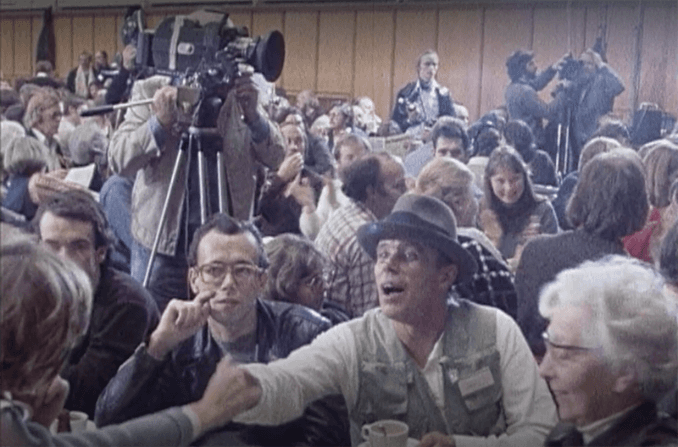
Joseph Beuys at the founding congress of the Green Party, 1980 – Source: Panorama TV-Show, das Erste
At the end of the 1970s, the Green Party stepped into this political vacuum. It was formed on the basis of left-wing principles and spoke out against environmentally destructive wars and ‘reckless’ capitalism (and communism). Beuys made a pioneering contribution right from the start, back in 1978, when the party's manifesto was being drawn up. He campaigned on podiums, in the media and in pedestrian zones for the upcoming election. In addition, he made his studio available to the party, donated money and designed a motif for an election poster. Beuys was thus a founding member of a party that ultimately even co-governed in the German Bundestag until 2024.
But when the Green Party entered the Bundestag in 1983 with 5.6% of the vote, Beuys was no longer part of it. After failing to secure a top spot on the party list, he withdrew his candidacy for the federal election in 1982. Art was never to become a central feature of the Green Party – it was too strongly associated with elitism. Beuys' criticism of representative democracy was also hardly compatible with the goals of the pragmatists in the party. Although he was a founding member of the Green Party, the party was able to function successfully without him. Politics was clearly not dependent on utopian art.
Beuys' political aspirations repeatedly failed to translate his ideology into reality. His Organisation for direct democracy through referendums never achieved its goals, his concept of the Free International University was never realised, and even within the Green Party he ultimately remained a small cog that was easily replaceable. Up to this point in the story, politics seems to have the upper hand over art. Art appears to be a disruptive factor: sometimes, if it provokes too strongly, it is allowed to have its say for a moment, only to be ignored again afterwards.
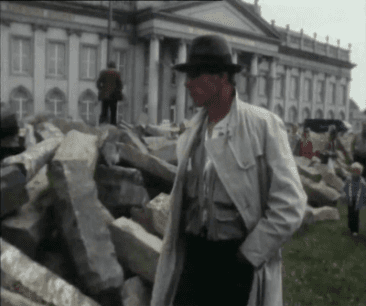 Joseph Beuys in front of “7000 Oaks – Urban Forestation Instead of Urban Administration”, 1982 – Quelle: Joseph Beuys 7000 Oaks | Documentation | 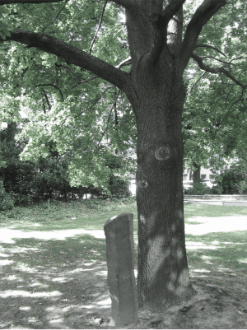 One of the oaks, circa 2008 |
However, Beuys remained undeterred. For Documenta 7 in 1982, he created the artwork ‘7000 Oaks – Urban Greening Instead of City Administration’. The artist placed 7,000 basalt stones in front of the exhibition building. Art dealers and visitors could later purchase a stone for 500 DM (approx. 260 euros). For each stone sold, Beuys planted a tree in the city. In this way, he succeeded in combining consumerism with ecological commitment. A concept that is all too familiar today.
Nowadays, it is no longer shocking when companies such as the search engine Ecosia (which plants trees for every search query) combine consumption with environmental awareness. But back then, this kind of thing was pretty much unheard of. Beuys’ artwork, which was dismissed as a utopian vision at the time, has become common practice years later. In this way, art can convey progressive ideas that, after initial rejection, are later adopted by politics and society.
Joseph Beuys' political career was nowhere near as successful as his artistic one. However, the idea that art must be subordinate to politics proves to be a fallacy. Beuys may not have been able to change politics from within, but his art had an impact from the outside: his call for the abolition of the East-West border was partially implemented years later, his connection between consumption and environmental awareness is commonplace today, and the recognition of the indigenous peoples of America that he sought has increased significantly in recent years.
It is precisely the utopian visions of art that seem to drive politics forward years later. Perhaps art can therefore be seen as the real progressive engine of politics. A medium that is in no way suppressed by politics, but actively guides it.
Doc/34 all rights reserved, sponsored by IFM.
" height="65.65946764590899px" id="biO_icj08" transform="translate(0 1.371)" width="59.174572953517554px"/><path d="M 63.167 33.692 C 63.167 54.377 50.565 68.088 31.544 68.088 C 12.524 68.088 0 54.69 0 33.927 C 0 13.163 12.371 0 31.626 0 C 50.882 0 63.17 13.163 63.17 33.692 Z M 46.89 33.848 C 46.89 21.155 41.097 13.477 31.626 13.477 C 22.155 13.477 16.206 21.234 16.206 33.848 C 16.206 46.463 22.077 54.533 31.626 54.533 C 41.176 54.533 46.89 46.698 46.89 33.848 Z" fill="rgb(0, 0, 0)" height="68.08839784893921px" id="A8_8V8D77" transform="translate(58.705 0.196)" width="63.17042207703656px"/><path d="M 43.755 24.133 C 42.268 17.003 38.119 13.477 31.388 13.477 C 21.838 13.477 16.281 20.998 16.281 33.927 C 16.281 46.855 22.073 54.455 31.779 54.455 C 36.084 54.455 39.763 52.653 42.033 49.519 C 43.363 47.638 43.911 46.071 44.381 42.781 L 60.662 45.209 C 59.175 51.869 57.453 55.709 54.165 59.548 C 49.312 65.111 41.72 68.088 32.249 68.088 C 22.778 68.088 14.637 65.111 9.08 59.47 C 3.287 53.593 0 44.426 0 33.927 C 0 23.427 3.287 14.26 9.471 8.149 C 14.872 2.899 22.778 0 31.935 0 C 42.033 0 49.938 3.448 55.026 10.264 C 57.531 13.477 58.861 16.376 59.879 20.998 Z M 100.346 1.41 L 72.246 77.804 L 58.235 77.804 L 86.414 1.41 Z" fill="rgb(0, 0, 0)" height="77.80411839929134px" id="v1AksvdEb" transform="translate(121.519 0.196)" width="100.34629996240147px"/><path d="M 16.594 46.933 C 17.064 49.519 17.533 50.616 18.786 51.948 C 20.899 54.142 24.03 55.317 27.787 55.317 C 33.892 55.317 37.728 52.261 37.728 47.482 C 37.728 44.269 36.162 41.762 33.501 40.743 C 31.701 40.117 29.274 39.725 26.222 39.725 C 23.169 39.725 19.647 39.881 16.594 40.195 L 16.594 26.718 C 19.255 27.032 21.838 27.188 24.891 27.188 C 32.327 27.188 36.006 24.681 36.006 19.666 C 36.006 15.435 33.031 13.007 27.865 13.007 C 22.308 13.007 19.49 15.2 18.316 20.215 L 1.409 17.786 C 2.896 12.928 4.148 10.578 6.653 7.835 C 11.428 2.664 18.629 0 28.178 0 C 36.71 0 43.755 2.351 48.216 6.66 C 51.112 9.559 52.6 13.32 52.6 17.786 C 52.6 26.091 48.138 31.263 39.137 33.378 C 43.911 34.083 46.494 35.18 49.234 37.531 C 52.521 40.508 54.4 44.583 54.4 49.127 C 54.4 53.123 53.304 56.806 51.269 59.548 C 49.547 61.899 46.807 64.092 43.911 65.424 C 39.841 67.305 33.501 68.48 27.63 68.48 C 20.586 68.48 13.541 66.835 9.393 64.092 C 5.792 61.742 3.053 58.294 1.331 53.985 C 0.861 52.888 0.548 51.869 0 49.832 Z" fill="rgb(19, 136, 8)" height="68.48016075605614px" id="UrmKxPWFQ" transform="translate(219.752 0)" width="54.399905030019454px"/><path d="M 0 37.844 C 2.348 35.233 4.853 32.36 7.514 29.226 L 24.5 9.324 C 28.257 5.015 29.744 3.056 31.779 0 L 47.825 0 C 47.355 4.623 47.199 7.757 47.199 13.007 L 47.199 38.471 L 49.469 38.471 C 51.895 38.471 54.478 38.236 57.218 37.844 L 57.218 52.104 C 54.87 51.791 51.973 51.634 49.547 51.634 L 47.199 51.634 L 47.199 55.552 C 47.199 59.94 47.355 62.212 47.825 65.189 L 31.701 65.189 C 32.092 62.525 32.327 59.235 32.327 55.395 L 32.327 51.556 L 10.176 51.556 C 5.088 51.556 2.896 51.634 0 51.869 Z M 32.405 29.539 C 32.405 26.013 32.562 21.704 32.875 18.256 C 31.309 20.45 30.135 22.017 28.022 24.681 L 16.594 38.628 L 32.405 38.628 Z" fill="rgb(19, 136, 8)" height="65.18935212489366px" id="nz3MAn0g5" transform="translate(272.782 1.567)" width="57.21774185674667px"/></g></svg>)