Identities
Community first, concept second; An interview with Alexandre Slama from Buck Fried Chicken
By Caroline Kohler
Honestly, fried chicken is just an excuse for me to express myself creatively.
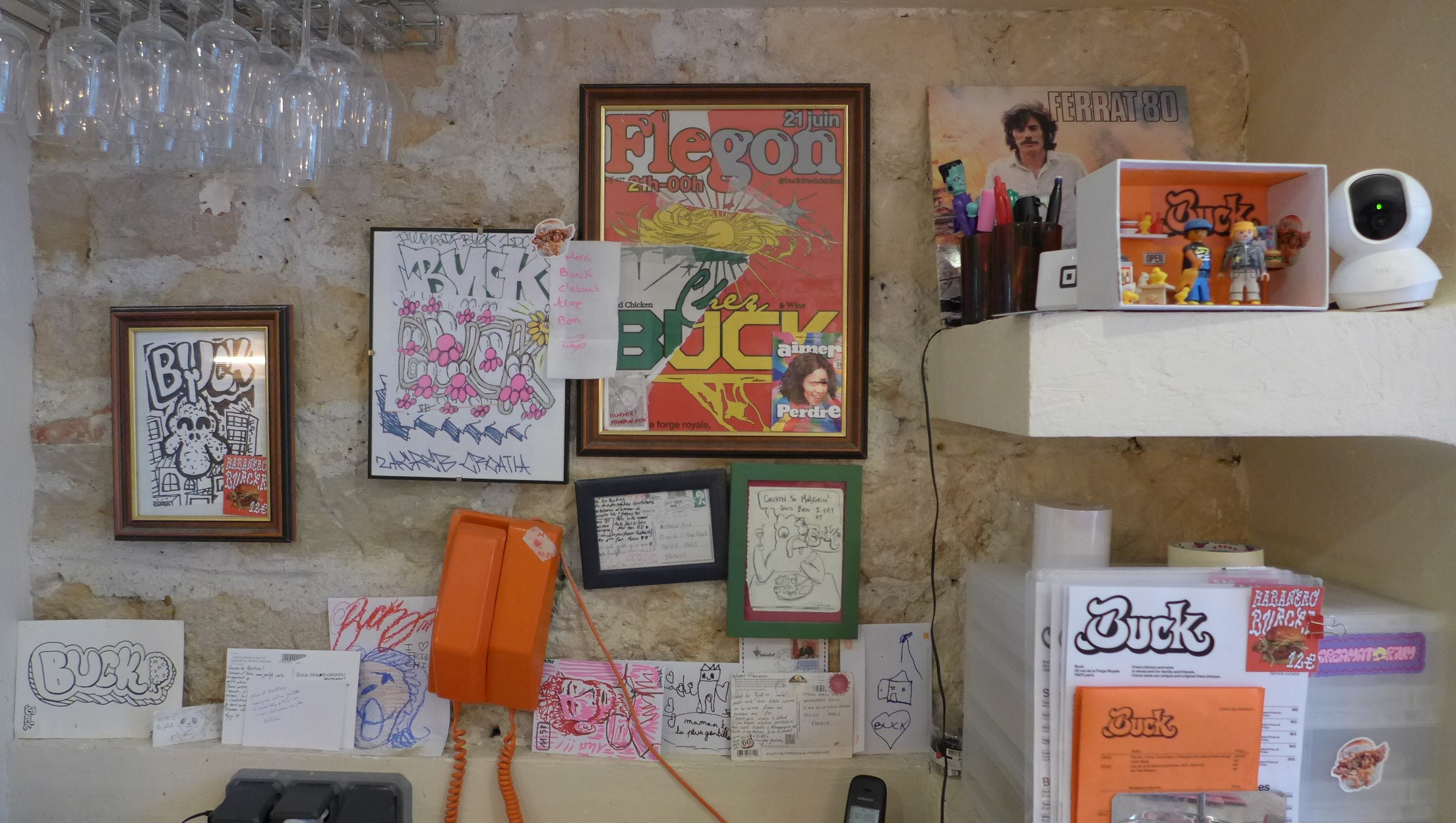
Caroline
To start, could you introduce yourself, explain a bit what you do, your background, your role today, Buck, how it came about, how long the place has existed, and where you’re from as well?
Aless
Of course. My name is Alexandre Slama. But everyone calls me Aless, whether in the restaurant world or even before. It’s kind of my nickname. I come from the digital world. I went to a school called HETIC, which offers an engineering degree in computer science. So I learned how to code applications and websites. I also learned how to sell them- I had a pretty solid sales training. And at the same time, I also dabbled a bit in visual and image-related work.
Basically, I don’t really have one specific specialty. I’m not particularly excellent in one precise thing- I’m kind of average at lots of things. But because I have access to all these tools and I learned how to use them, it gives me a lot of creative freedom.
I went through many types of jobs. After school, I worked as a salesperson in a digital agency during Covid, selling websites. At some point, it didn’t make much sense to me anymore. So I left the company, and they told me clearly that they weren’t really trying to keep me either.
I started thinking about doing something solo, a project called Bloop at the time. It was a T-shirt brand in collaboration with artists from all over the world, the only constraint was that they had to write “Bloop Blop” on the artwork. Other than that, it could be anything they imagined. I did a first “season”- big quotation marks, because it was really a small project- but it allowed me to live for about two months. And above all, I was really happy to have created my first structure on my own. There was some resonance on Instagram, even if it was mostly from people close to me. It allowed me to feel like I was entering the professional world. I was genuinely enjoying myself- it was a dream, I loved it.
Not long after, I brought a friend into Bloop. He wasn’t a fan of the name, not a fan of the art direction, and in general he didn’t really like the project. So I modified the project for him. That was when I lost ownership of it, it wasn’t really mine anymore. So we stopped very naturally.
The idea of creating a restaurant followed very quickly. Gastronomy is really my passion- food, eating, opening the fridge all day- that was my thing.
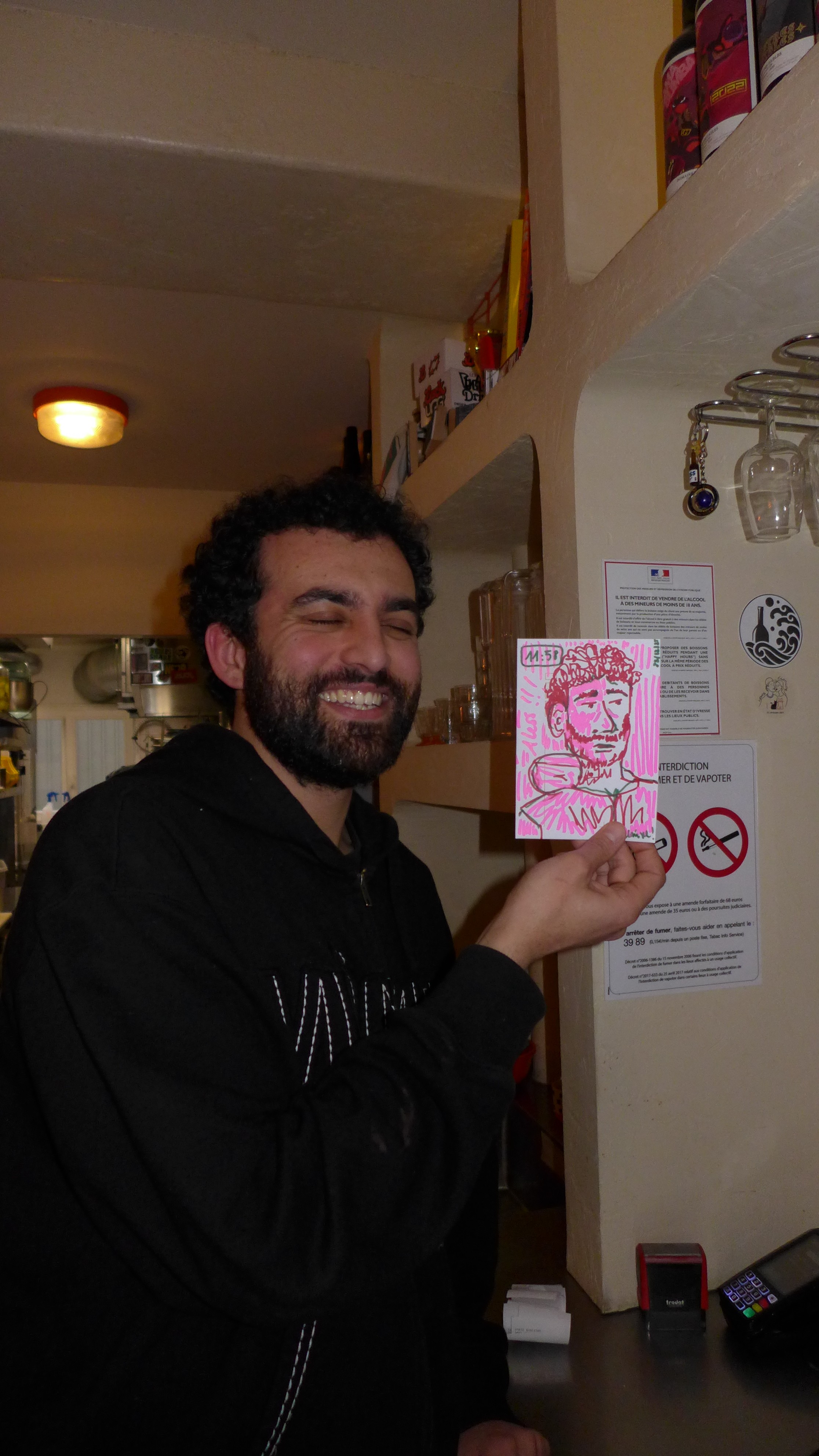
Alexandre Slama photographed by Caroline Kohler
Caroline
And why fried chicken in particular?
Aless
Originally, it was to respond to the demand of a market that had never really had this product before: the kosher market. In the Jewish community, you don’t mix milk and meat- that’s one of the rules. So, in theory, you can’t really have fried chicken, because there’s a chemical reaction between milk and meat in the usual recipes.
I saw it as a challenge. It really obsessed me. I started experimenting with recipes on my own. At some point, I felt like I had something cool. I already had the name and a pretty clear idea of the universe behind the name: the colors, the tone, the language.
Then I called my best friend from high school, Balthus, my business partner. Balthus works in the restaurant industry. He’s Franco-American. At the time, he was in Denver with his brother and there was this funny coincidence: him and his brother were realizing that fried chicken was going to become the next big hit in global food culture. Because everything that happens in the United States, France experiences it a few years later- especially in food.
Balthus told me my recipe was terrible, but the idea itself was great. At first, he told me, “I’ll do a bit of consulting for you.” So we met, and then met more and more, and our relationship became professional; it wasn’t just friendly anymore. Sometimes the professional relationship takes more space than the friendship, and you have to accept that when you work with close friends.
I was extremely attracted to the idea of opening a place. I absolutely wanted to test the product. That’s my developer background- you always need user testing to get feedback. So we opened as a dark kitchen at first, only for delivery, in a retirement home kitchen. It was a really shady setup, but we accepted it. We started selling fried chicken for the kosher market. It worked really well.
Then we said: why sell this only to a specific market? That’s ridiculous. So we started doing a lot of events to build some initial cash flow and to create a community around our product. After about a year of events, we went from around 200 to 3,000 followers on Instagram- people we had actually met and built a real relationship with.
We opened the restaurant because our community was asking for it, right here on August 28, 2023. And we were busy right away because we already had a community. It wasn’t just a new restaurant; it was the continuation of a project that had started two years earlier. That’s how Buck exists today. We still have the same base community, and now it has grown a lot. At first, it was really just fried chicken. Now it’s much more than that- it’s a whole universe.
Caroline:
In Paris, I think you know, we see more and more brand cafés, branded dinners, pop-up food concepts. I wanted to ask you, because in a way, eating has become a new form of self-expression in creative circles, and where you eat defines a bit who you are perceived to be. So to talk about the community aspect you mentioned, how do you think Buck positions itself in that landscape, and how do you see that?
Aless:
We had a bit of a realization when we opened here.
When we opened two and a half years ago, there was already this craze around cafés and constant new openings. Instagram was full of that. The whole market was only talking about new concepts. Every day there was a new concept opening.
We tried to distance ourselves from this very “conceptual” side. Because “conceptual” often also means ephemeral. People get attached to gimmicks- triangle-shaped pizzas, business-school guys launching concepts, or even passionate people who almost feel forced, in the Parisian market, to conceptualize their project to make it sexier.
We were lucky, because we built a community around our fried chicken, not around a specific concept. It was really the recipe, born from a constraint- creating a plant-based “milk” to answer the kosher restriction. And in the end, people in the 11th arrondissement saw it as a lighter, more digestible breading. It’s a small detail, but it brought in more people.
We built this community, we started doing small events, and we added a wine element: we did events in bars where they sold alcohol and we sold our chicken. So naturally, at the table, you’d have a bottle of red wine and fried chicken. That’s why we opened here with the subtitle “Fried chicken and wine,” because we found it funny- the idea of sitting at a table with fried chicken, breaking the codes between fast food and more traditional dining.
If we have a “concept,” it’s probably that.
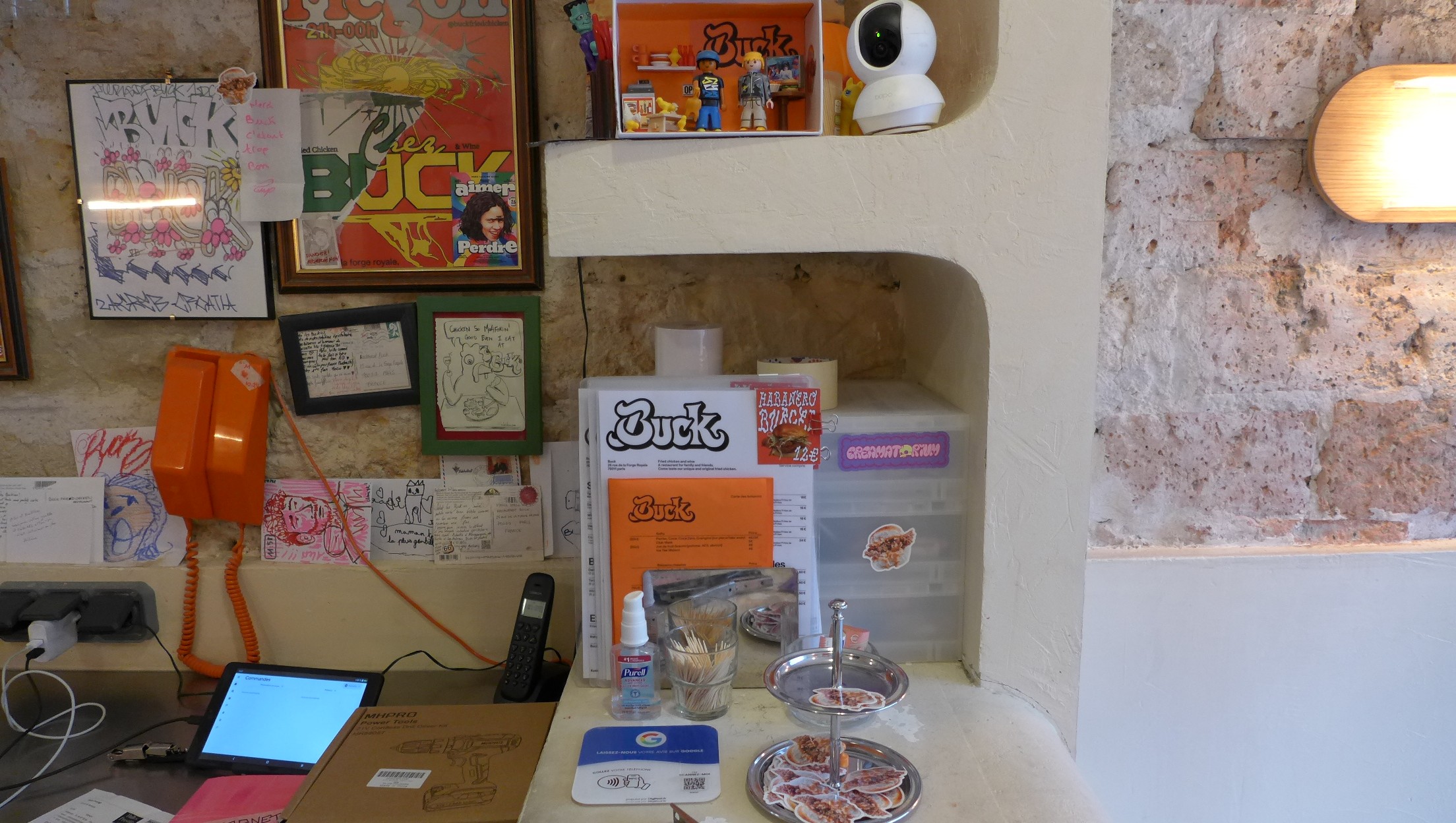
Image by Caroline Kohler
But overall, we don’t really consider that we have a single differentiating “concept.” We think we have a universe that’s welcoming and warm. Hospitality is at the center of everything. The community is the main entry point of our whole thinking process.
What matters most to us is that people are happy with the Buck experience as a whole. It’s not just about having eaten fried chicken. For example, we recently made our restaurant playlist public because people kept asking for it. People save it on Spotify. Those little details create a sense of community too. People don’t necessarily need to come eat here to feel connected. They can connect with a color, an identity, a tone of voice, and personalities, and this community is the same one we address through our food, our music, our merch, our collaborations.
We’re not trying to attract communities that aren’t meant for us. If you connect with what we’re building, then you’re part of it. Our community is actually very eclectic: we have older people, families, kids, people from fashion, cinema, random locals, lots of tourists. And all of that contributes to what Buck is today.
So yes, community is essential. But it has to be anchored in a real product. Not just something conceptual and ephemeral, but something tangible and long-term. At first, you define a product that creates a community. And then, over time, that community ends up shaping the product.
It’s a bit like content creation. You try many formats- outfit of the day, “inside someone’s closet,” interviews, different video formats. Some work particularly well, and naturally you end up focusing on those. But you still keep the other formats because they excite you creatively. Buck developed in a similar way.
Caroline:
To build on what you said about community, we see a lot of music, cinema, and fashion mixing more and more with food. I know you’ve worked with Nelick, who’s a rapper a lot of people from my generation listen to, and with emerging rappers in Paris like Romsii. You’ve also worked with La Fam Amsterdam during Fashion Week, like you told me on the phone.
So I wanted to ask: how do you choose who you collaborate with? When a brand comes to you and says, “Hey, I’d like to work with you,” how do you decide? Creatively, and also in terms of what you want Buck to be?
Aless:
The most important thing in a collaboration is that it makes sense. That it’s coherent with what we’ve built.
Let me give you a very concrete example: UGG. We did a collaboration with the brand about a year ago. We hosted their Fashion Week after-party here. They presented products, then wanted to bring people here for a party. We hesitated at first, because UGG can be problematic from an ethical standpoint- animal welfare, for instance. At the time, it was a bit sensitive.
So there’s always this dual feeling: you’re flattered, but you also question whether it makes sense. And you can’t lie to yourself- there’s also a financial reality. An event like that brings money, exposure, and visibility.
So we try to align with a collaboration on three levels: does it fit our values and the communities we care about, does it make sense for our own community and is it interesting financially or in terms of the visibility we gain. If all of that aligns, we go for it.
Some collaborations are purely passion projects, like with Nelick. There’s no money in that. It’s not even about bringing in more customers. I know Nelick personally. He came to an event we did for Halloween, where we had one of the DJs from Cassius playing. He saw the vibe, the crowd, and said: “Let’s do something together.” That’s how we created the “Goofy & Spicy” event.
It wasn’t just a signature or a pop-up. We created a whole universe: a name, packaging, visuals, a special spicy product for that event. We met his team. Our communities mixed really naturally. And that’s the most important thing: coherence. Our community loved it. His community loved it. We created a product that worked specifically for that moment.
If I had to sum it up in one word: coherence.
I wouldn’t do an event with Amazon, even if they offered me an insane check, because it wouldn’t make sense for what we’ve built. Unless Amazon suddenly started making fried chicken- then maybe there would be coherence. It’s not political; it’s about not breaking what we’ve built over the years.
I want to be able to look back later and say: “We stayed coherent. We didn’t betray anyone.”
Caroline:
On that note, your project attracts very different profiles in your clientele, like you said: people from fashion, music, creatives, and also locals from the neighborhood. I wanted to know how you see all these different worlds coexisting around Buck. Is it something you actively encourage, or something you’re more cautious about? And how do you personally experience that, because your restaurant is a big project.
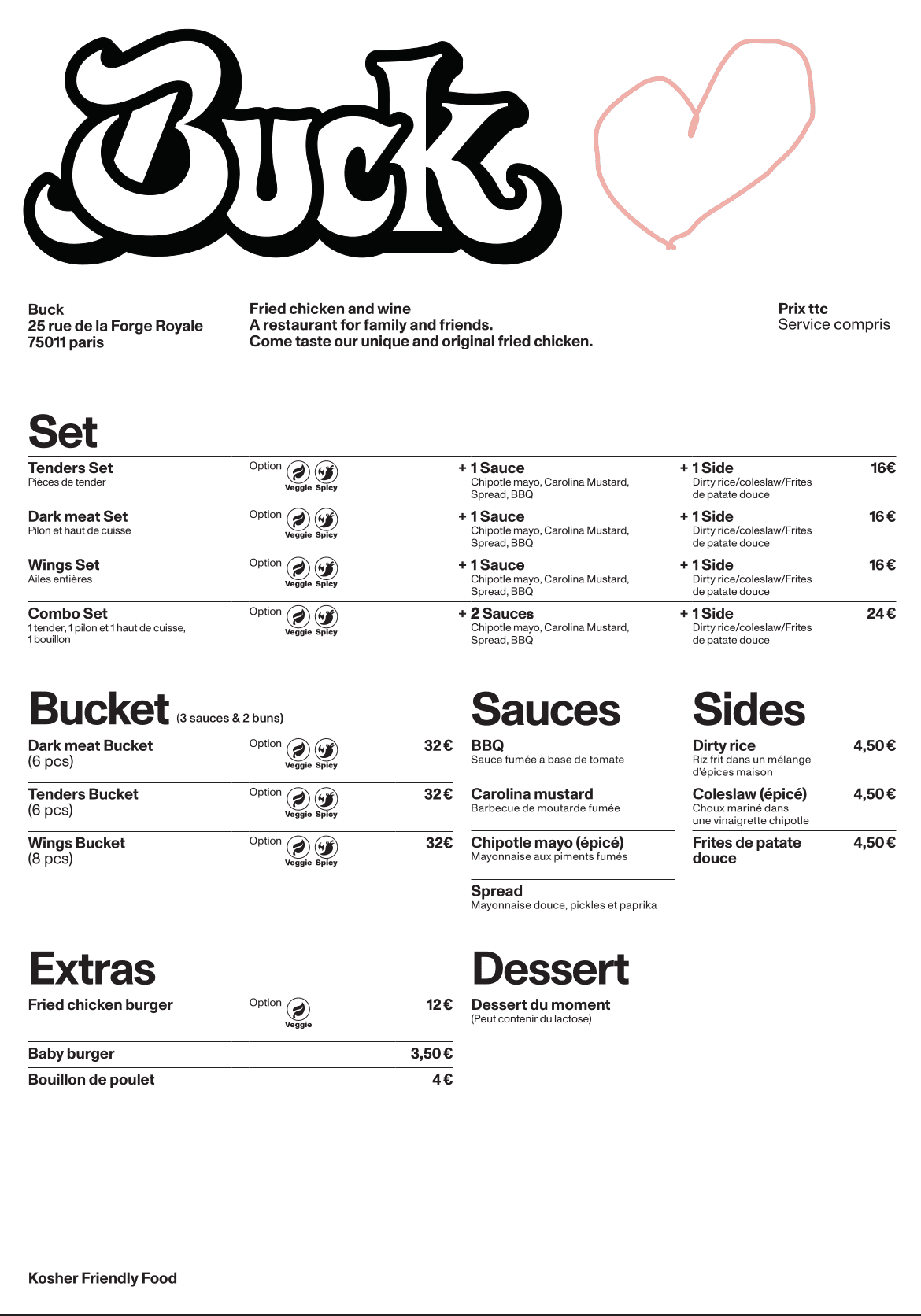
Buck's Menu
Aless:
We actively encourage diversity.
I’m going to get a bit personal for a second: when I was younger, I used to lie a lot because I lacked confidence. I had different groups of friends who never met each other. I was against mixing worlds.
Opening a restaurant forced me to accept that all these people met naturally. And in a way, they all had one thing in common: me. With customers, it’s similar. They all have one common point: at the very least, they like fried chicken, they validate our recipe, or they connect with our visual identity.
So what world you come from doesn’t really matter. You’re sitting at the same table, eating the same fried chicken, listening to the same music, attending the same events, paying the same price. Everyone is on the same level here. That’s what I love. The door is literally always open in summer. People come in, hang out, do their thing. You have to accept and encourage that melting pot. That’s what made Buck what it is today.
What makes me happiest is seeing very different people coexist in the same space: four guys doing motion design at the bar, two people from the film industry talking about their next project, a random couple on a date, a family with kids. And they all eat the same thing. We’re almost mono-product: it’s all fried chicken. That simplicity is unifying.
Hospitality is maxim. We’re always kind, we welcome everyone. The delivery drivers are part of the community- they don’t wait outside, they come in, get water, chat, and relax while waiting for their order. It’s very family-like. Maybe too much. But that openness is really part of our DNA. “Fried chicken for everyone” is literally our mindset.
It’s funny because the project started as something meant for a very specific community. At the beginning, it was even a bit of a business move- we thought, “This is going to work, we’re going to make money.” You quit your job, you have no safety net, you have to think business. But I’m really happy that today it brings together such different people.
Caroline:
To move to the more creative side: I know you developed the visual identity with Golgotha. Could you explain your creative process? You told me you already had a very concrete idea of what you wanted. What were your inspirations- cinema, music, American references, colors?
Aless:
Honestly, when I decided to launch fried chicken, I already had the name, the orange color, the tone of voice, the freedom in the language. I knew I didn’t want something clean and cold like many Italian restaurants on Instagram, with standardized emojis and corporate language. I wanted something freer, almost a bit trashy. I’m a child of MTV and Vice. I didn’t skateboard, but I’m part of that generation. My partner skates, I was surrounded by that culture.
I grew up with strong personalities. Jim Carrey shaped me. Action Bronson shaped me. Musically, I’m influenced by PC Music, Caroline Polachek, Oklou. I’ve always been sensitive to American branding, strong typography, bold visuals. It’s a visual memory I’ve had my whole life. Orange I find beautiful, but with subtlety. The restaurant isn’t fully orange: it’s in small details- the lamp, the curtain, the wine menu.
My mother is a major creative figure who worked in big fashion houses, my father is a photographer, my brother is a musician. Art has never been secondary in my life. For me, it’s first a matter of artistic discussion- then business comes after. It’s something visceral. I can be happy just listening to music alone with headphones or going to a concert. That’s enough for me.
At first, I designed the logo myself because we didn’t have money. I created a small mascot called Bucky when we were a dark kitchen. When we opened the restaurant, we “killed” the mascot because we wanted Buck to be embodied by us, not a cartoon.
We already had the color palette: orange, green at first, and this specific off-white color (a Parisian RAL shade you see on the walls here). Then we realized we needed professionals to help us go further. That’s how Golgotha came in. They’re extremely strong in fashion and music branding, and their first proposals were immediately spot-on. They saturated the orange, removed the green, refined the beige, and drew a logo by hand.
They really understood our level of detail. Even the concrete textures in the restaurant were designed to evoke the texture of fried chicken. We built most of the furniture ourselves, almost nothing here was bought- it was crafted. They even suggested putting a huge sign outside that simply says “Restaurant.” I loved that idea: like a pharmacy says “Pharmacy,” a bookstore says “Bookstore.” Here, it’s just “Restaurant.” Then inside, you enter the Buck universe.
Today, Golgotha helps us with event posters, merch, collaborations like with Shot New York. There’s a real love story between us creatively. We speak the same language.
Caroline:
Last question: if you weren’t in the restaurant business, what industry do you think you would work in?
Aless:
Honestly, fried chicken is just an excuse for me to express myself creatively.
I don’t see myself staying in the restaurant industry forever. If Buck grows a lot, I could imagine opening a creative consulting agency for restaurants, focusing on visual identity, storytelling, and design. But music is really what calls me.I’m not a musician, but I have an ear. I love music deeply. I’ve done solfège, drums, guitar. I’m obsessed with certain artists. I’ve followed them closely from early on. I think I would have worked in music production. Supporting artists, building artistic direction. I can’t imagine my life without being involved in a musical adventure at some point.
So yes- if not food, definitely music. It’s inevitable.
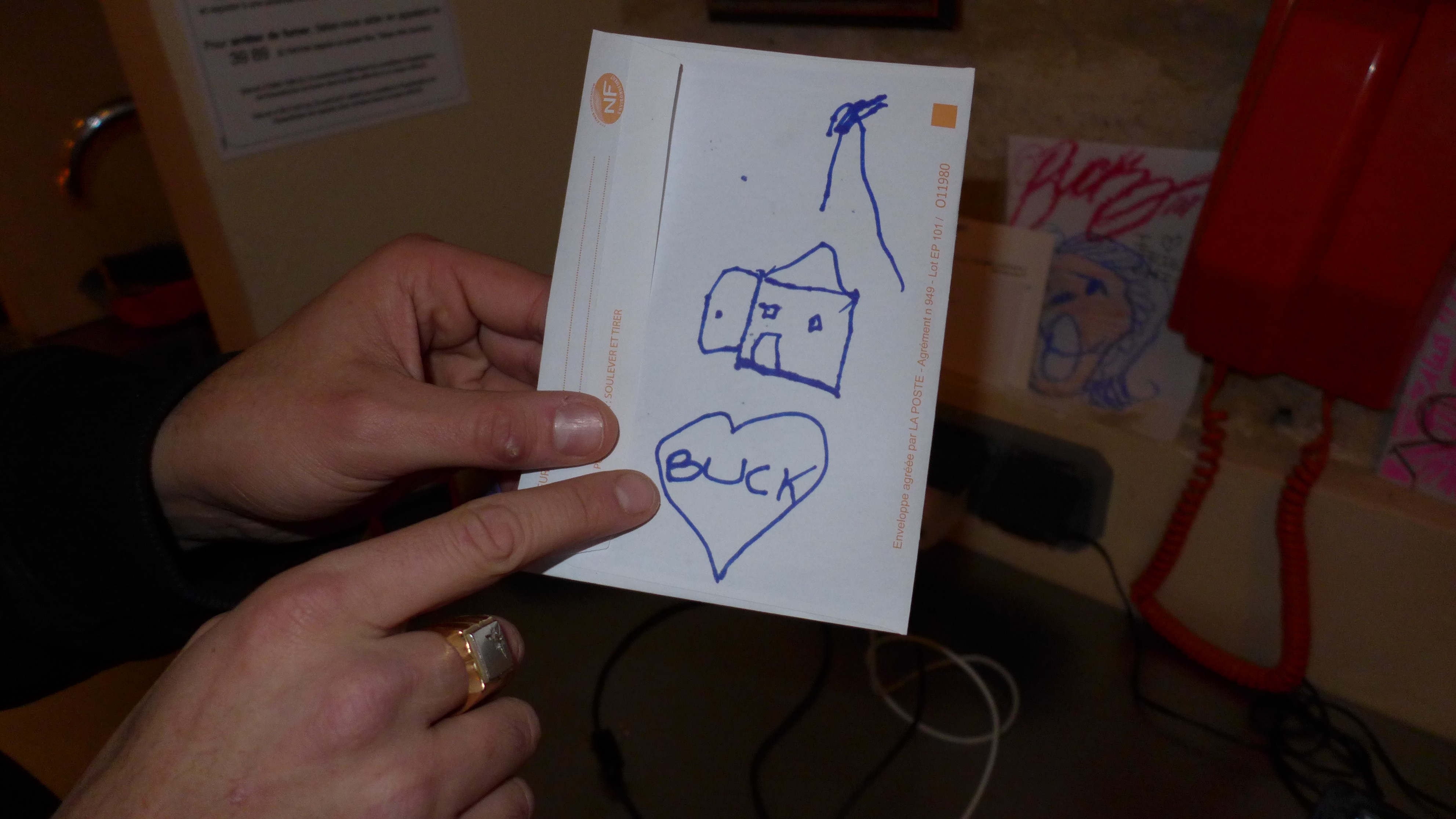
Image by Caroline Kholer
Find buck on Instagram : @buckandmore
Doc/34 all rights reserved, sponsored by IFM.
" height="65.65946764590899px" id="biO_icj08" transform="translate(0 1.371)" width="59.174572953517554px"/><path d="M 63.167 33.692 C 63.167 54.377 50.565 68.088 31.544 68.088 C 12.524 68.088 0 54.69 0 33.927 C 0 13.163 12.371 0 31.626 0 C 50.882 0 63.17 13.163 63.17 33.692 Z M 46.89 33.848 C 46.89 21.155 41.097 13.477 31.626 13.477 C 22.155 13.477 16.206 21.234 16.206 33.848 C 16.206 46.463 22.077 54.533 31.626 54.533 C 41.176 54.533 46.89 46.698 46.89 33.848 Z" fill="rgb(0, 0, 0)" height="68.08839784893921px" id="A8_8V8D77" transform="translate(58.705 0.196)" width="63.17042207703656px"/><path d="M 43.755 24.133 C 42.268 17.003 38.119 13.477 31.388 13.477 C 21.838 13.477 16.281 20.998 16.281 33.927 C 16.281 46.855 22.073 54.455 31.779 54.455 C 36.084 54.455 39.763 52.653 42.033 49.519 C 43.363 47.638 43.911 46.071 44.381 42.781 L 60.662 45.209 C 59.175 51.869 57.453 55.709 54.165 59.548 C 49.312 65.111 41.72 68.088 32.249 68.088 C 22.778 68.088 14.637 65.111 9.08 59.47 C 3.287 53.593 0 44.426 0 33.927 C 0 23.427 3.287 14.26 9.471 8.149 C 14.872 2.899 22.778 0 31.935 0 C 42.033 0 49.938 3.448 55.026 10.264 C 57.531 13.477 58.861 16.376 59.879 20.998 Z M 100.346 1.41 L 72.246 77.804 L 58.235 77.804 L 86.414 1.41 Z" fill="rgb(0, 0, 0)" height="77.80411839929134px" id="v1AksvdEb" transform="translate(121.519 0.196)" width="100.34629996240147px"/><path d="M 16.594 46.933 C 17.064 49.519 17.533 50.616 18.786 51.948 C 20.899 54.142 24.03 55.317 27.787 55.317 C 33.892 55.317 37.728 52.261 37.728 47.482 C 37.728 44.269 36.162 41.762 33.501 40.743 C 31.701 40.117 29.274 39.725 26.222 39.725 C 23.169 39.725 19.647 39.881 16.594 40.195 L 16.594 26.718 C 19.255 27.032 21.838 27.188 24.891 27.188 C 32.327 27.188 36.006 24.681 36.006 19.666 C 36.006 15.435 33.031 13.007 27.865 13.007 C 22.308 13.007 19.49 15.2 18.316 20.215 L 1.409 17.786 C 2.896 12.928 4.148 10.578 6.653 7.835 C 11.428 2.664 18.629 0 28.178 0 C 36.71 0 43.755 2.351 48.216 6.66 C 51.112 9.559 52.6 13.32 52.6 17.786 C 52.6 26.091 48.138 31.263 39.137 33.378 C 43.911 34.083 46.494 35.18 49.234 37.531 C 52.521 40.508 54.4 44.583 54.4 49.127 C 54.4 53.123 53.304 56.806 51.269 59.548 C 49.547 61.899 46.807 64.092 43.911 65.424 C 39.841 67.305 33.501 68.48 27.63 68.48 C 20.586 68.48 13.541 66.835 9.393 64.092 C 5.792 61.742 3.053 58.294 1.331 53.985 C 0.861 52.888 0.548 51.869 0 49.832 Z" fill="rgb(19, 136, 8)" height="68.48016075605614px" id="UrmKxPWFQ" transform="translate(219.752 0)" width="54.399905030019454px"/><path d="M 0 37.844 C 2.348 35.233 4.853 32.36 7.514 29.226 L 24.5 9.324 C 28.257 5.015 29.744 3.056 31.779 0 L 47.825 0 C 47.355 4.623 47.199 7.757 47.199 13.007 L 47.199 38.471 L 49.469 38.471 C 51.895 38.471 54.478 38.236 57.218 37.844 L 57.218 52.104 C 54.87 51.791 51.973 51.634 49.547 51.634 L 47.199 51.634 L 47.199 55.552 C 47.199 59.94 47.355 62.212 47.825 65.189 L 31.701 65.189 C 32.092 62.525 32.327 59.235 32.327 55.395 L 32.327 51.556 L 10.176 51.556 C 5.088 51.556 2.896 51.634 0 51.869 Z M 32.405 29.539 C 32.405 26.013 32.562 21.704 32.875 18.256 C 31.309 20.45 30.135 22.017 28.022 24.681 L 16.594 38.628 L 32.405 38.628 Z" fill="rgb(19, 136, 8)" height="65.18935212489366px" id="nz3MAn0g5" transform="translate(272.782 1.567)" width="57.21774185674667px"/></g></svg>)