Reflections
Les Espaces d’Abraxas- on form and function in public housing
By Leyla Boudieb
Atop a hill in Marne-la-Vallée sits a hefty concrete mass in faded terracotta and weathered lilac. A multitude of windows veer out into the valley and onto a high-traffic street. You get off RER A, cross a buzzingly lively shopping mall and then a sparsely lit parking garage. You come to a halt in front of a wall so high it does not occur to you to look up in search of its end. You penetrate the structure and stand in front of the Ricardo Bofill community centre. To your left, to your right, above you, is a web of bridges and staircases and winding pathways. A narrow staircase leads up onto a podium overlooking a gargantuan courtyard framed by facades with windows upon windows. Ornate with geometric forms resembling columns and arches, they evoke memories of Roman edifices and yet seem abstracted into uncanniness. The structure makes one wonder what spectacle it is built to host.
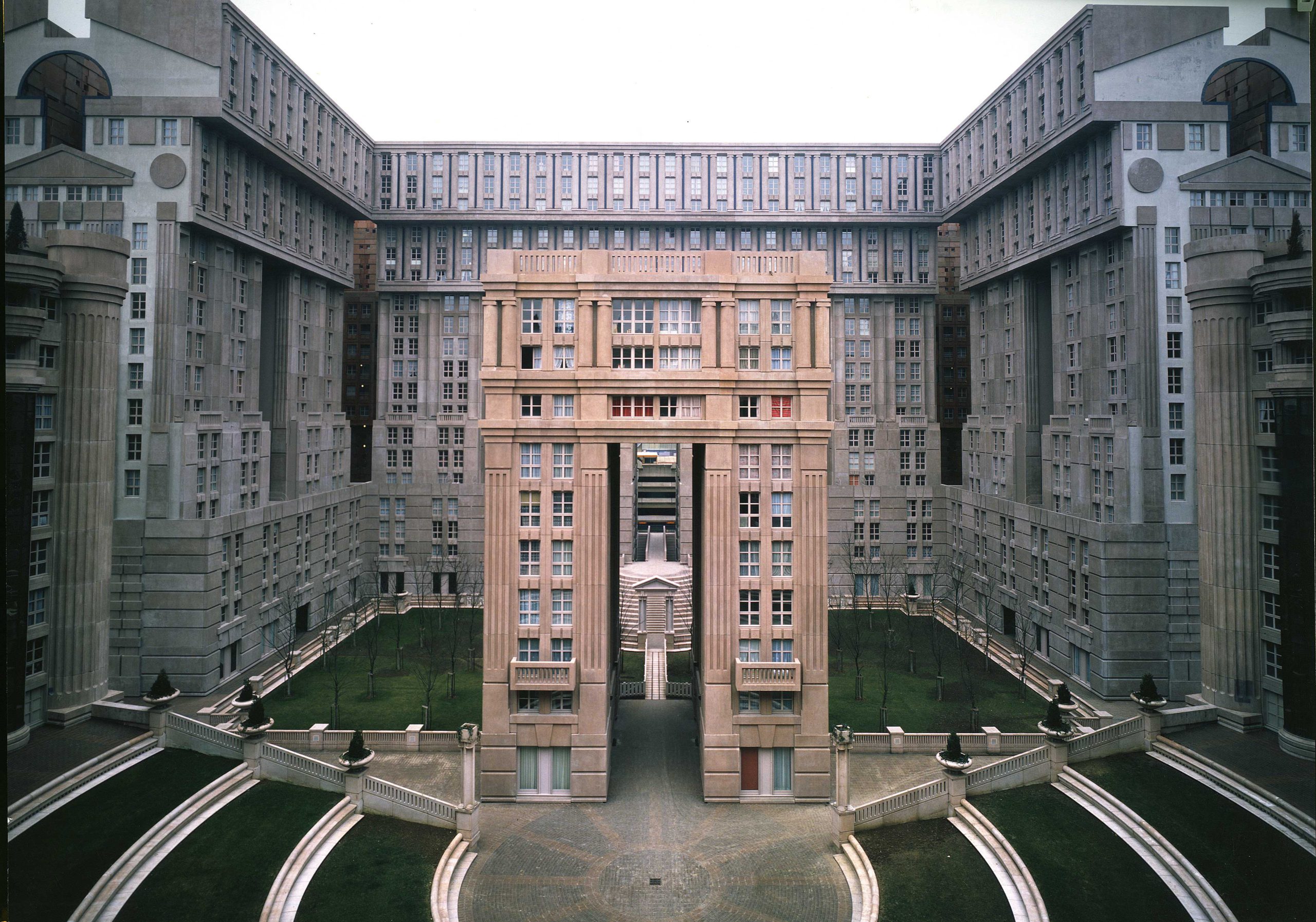
We are in Les Espaces d’Abraxas. Opened in 1982, the residential complex exemplifies Ricardo Bofill’s answer to the ‘second housing crisis’ France faced in the 1970s. Faced with an overwhelming influx of inhabitants after World War II, Paris had grown surrounded by the so-called grands ensembles, large housing structures in the periphery of the city built to satisfy the pressing housing shortage. Over the decades, living conditions in the newly built and densely populated towns had worsened significantly: poorly maintained, functionally standardised and far-off from the city’s infrastructure, the initial vision of new and self-sufficient towns surrounding the metropolis never materialised. Instead, life within the modernist housing complexes, conceived along Le Corbusier’s concept of the house as a machine à habiter, was characterised by isolation, dilapidation and dreary monotony.
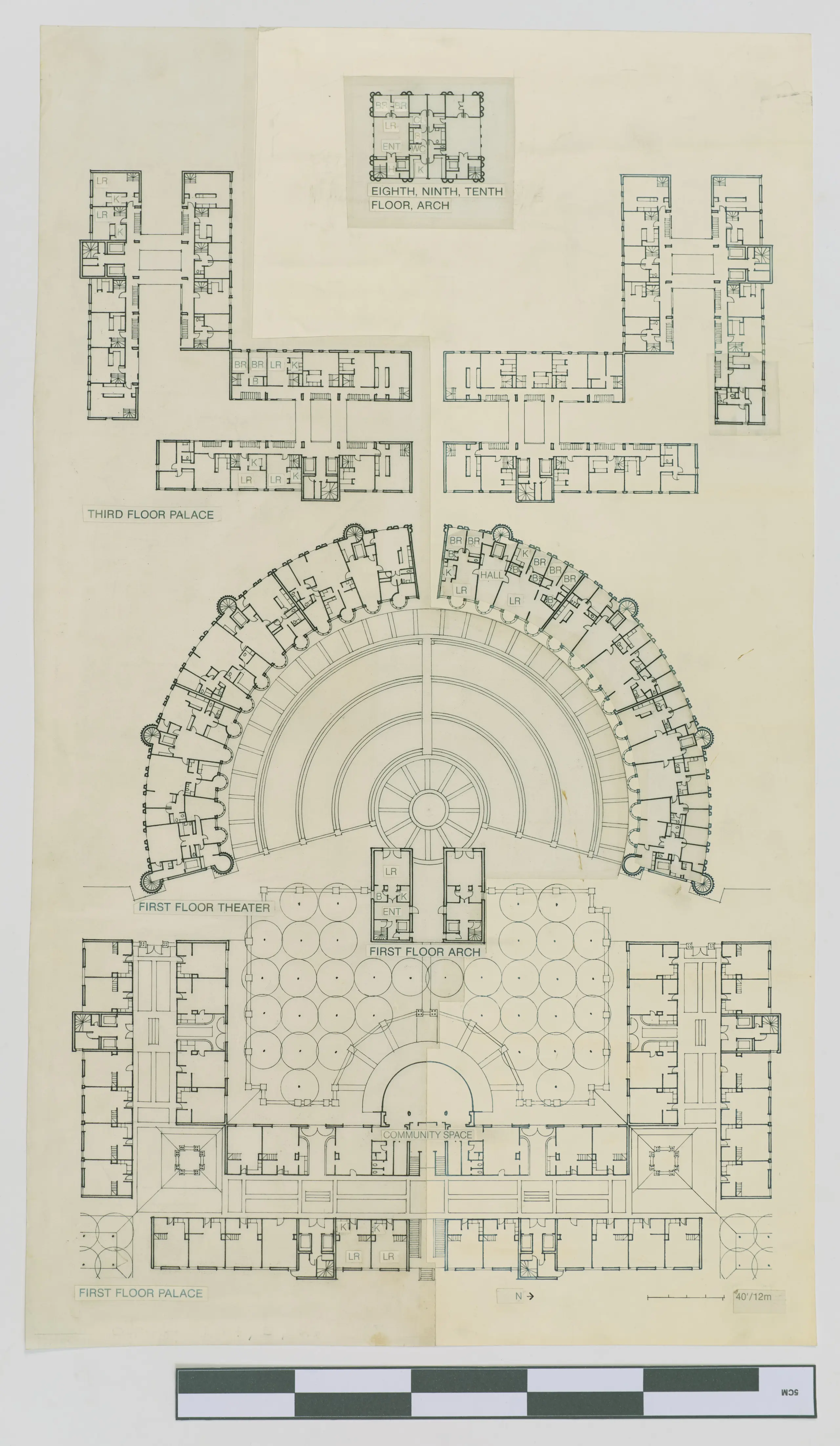
Bofill was tasked by the French government with building new complexes which would provide large amounts of housing that were to bear a solution to the issues the existing ones faced. Officials saw in his work a way to imbue social housing with civic dignity and sought to create a strong visual identity for the new town by giving it a monumental symbol at its entrance. Hence, he realised four large-scale housing projects in the Île de France region in the 70s and 80s, one of them being Les Espaces d’Abraxas in the nouvelle ville of Marne-la-Vallée, more specifically in Noisy-le-Grand. The complex is composed of three main buildings and houses a total of about 600 apartments: Le Palacio, 18 stories, with 441 units, and L’Arche, 10 stories, with 20 units, planned as social housing, and Le Théâtre, 9 stories, with 130 units available for purchase to private owners.
Courtesy of bofill.com
Plans to tear down the complex in the 2010s were ultimately abandoned in favour of a large-scale rehabilitation project announced in 2018, which Ricardo Bofill would plan and oversee. He famously refused the mayor’s requests to come back to Noisy-le-Grand for a long time, calling the project a failure and refusing to speak of it or touch it again. Ultimately, he was convinced and took on the challenge of its rehabilitation, set to be finished by 2027.
His plan included a project wherein residents became trained tour guides for the site: ten participated and composed a tour, each choosing one spot which was meaningful to their life within the structure to stop at. Samir Rouab still meets visitors in front of the community center for these guided tours every Sunday morning, including this rainy one in December. He moved here in the late 1980’s, he says, with his mother and siblings. Today, he lives here with a family of his own. Online, Tripadvisor and Google reviews detailing unpleasant or dangerous visitor experiences amass. In the beginning of our tour already, Samir asks us to be respectful and not film or photograph any residents. He speaks of his disdain with the negative image of the place being spread online. The structure, famed for its appearances in the Hunger Games, Brazil by Terry Gilliam or the music video for K-Pop artist Rosé’s “Number One Girl”, has grown to be somewhat of a tourist attraction, causing residents to become irritated when being filmed going about their daily lives by tourists. Architects Farrell and Furman posit the "unique combination of the romantic sublime and totalitarian awe", induced by the grand proportions and classical Roman, Greek and Baroque shapes in Les Espaces d'Abraxas, as a possible reason for its popularity as a "backdrop for dystopian feature films".
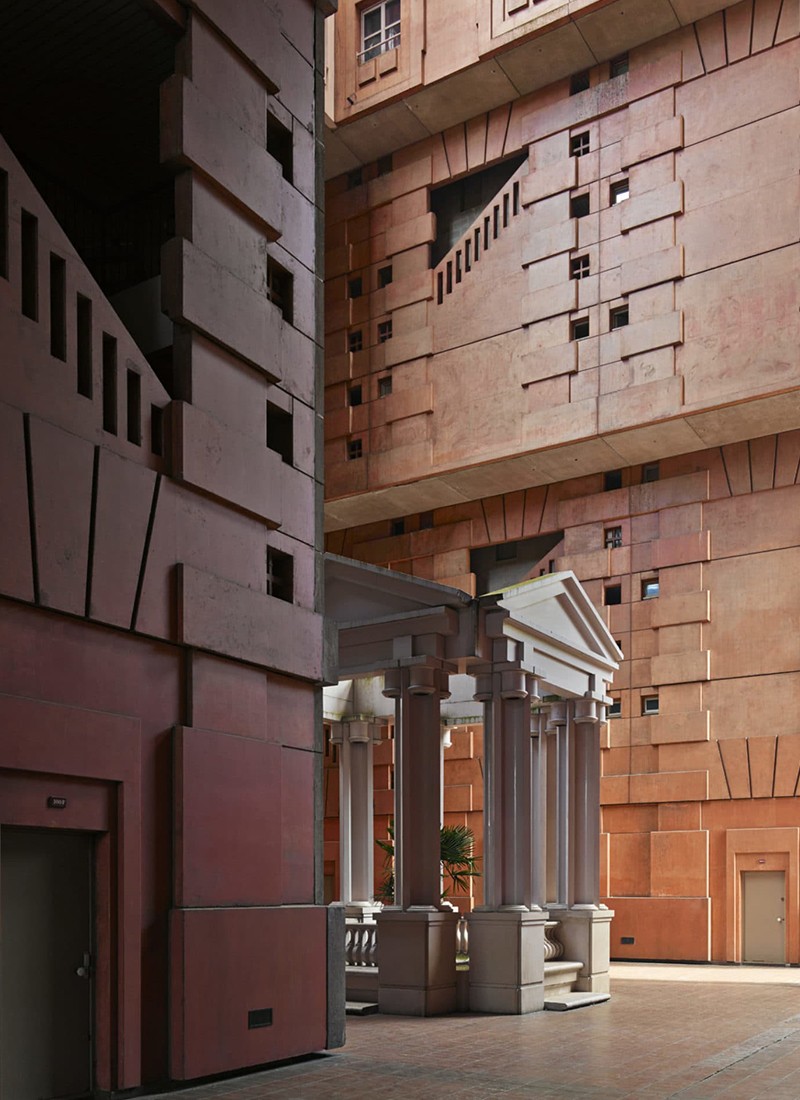
Postmodernism championed architectural symbolism, ornament and singularity as tools to communicate cultural values and give luxurious extravagance to social housing units, opposing the functional rationalism of the modernists. In this spirit, Bofill aimed for the structure’s neoclassical elements to evoke the image and air of antique edifices anchored in the collective subconscious. Realised in affordable and easily available prefabricated concrete, the entirety of the complex bears ornaments reminiscent of Greek and Roman temples and amphitheaters. Decorative slabs on the walls imply columns and arches and add a monumental quality to the exterior walls of the housing units.
Standing in front of le Théâtre, the amphitheatre-like tiered ‘gardens’ sprawl out in front of you. Through a slit in the middle of the half-circle, framed by a portal, one can glimpse outside of the structure. You are exposed to what feels like a million gazes, or more precisely those of six hundred apartments’ residents. The gardens in the courtyard were, in Ricardo Bofill’s plan for the structure, intended to be covered in greenery and trees to contrast the heavy, neoclassical concrete buildings. The courtyard was meant to have a lighting concept which would adapt according to the time of day, season and busyness of the space. The ground floor of the Palacio was intended to be lined with shops.
Photographes – © Jacques Pavlovsky – © Grégori Civera
Bofill dreamed of an enclave in Noisy-le-Grand where social classes would mix and coexist harmoniously, meeting in a large, green space shielded from outside noise. In his understanding, each of the residents was to be an actor in their own lives and simultaneously a spectator of others’. He wished to place the ordinary activities of the complex’s working class residents in an extraordinary setting: the monumental backdrop to their daily lives was to change the way they carried themselves and fill them with pride of their reality. He stood firm in his conviction that luxury, beauty and individuality should not be a privilege reserved for the elite, but a standard of living accessible to everyone. One of his core principles in the ideation of the Espaces d’Abraxas was that no two apartment layouts within them were to be identical, a goal accomplished largely by use of mezzanines in the Palacio complex.
The solution created a complex structure of half-floors: seen that the four elevators servicing the 441-unit building only lead to ‘full’ floors, a large portion of apartments is only accessible by taking an additional staircase up or down to the next half-level. The two sides of the building are connected by bridges. The resulting labyrinth of corridors is notoriously easy to hide and disappear in and makes police interventions tedious and difficult. The elevators that do exist, while already arguably insufficient, are perpetually broken and take days to fix, forcing residents to rely on the hazardously slippery and steep staircases to access their apartments- a continuous obstacle for those with limited mobility. Little light penetrates the deep and nested structure.
Embracing the back end of the complex stands Le Théâtre with the privately owned apartments. It is an overabundantly lit and ventilated bow of one-way mirrored column-like protrusions and windows upon windows with white latticing facing the other two buildings. Here, the singular layouts of the apartments make the window bays fall randomly into kitchens or bedrooms, thrusting the intimacy usually contained in a private home onto center stage.
On the way up to the 18th floor of the Palacio, we ride the elevator with a woman. “It’s a monster”, she scoffs. She’s not exactly wrong. Nowadays, the ownership structure of the units is extremely fragmented- some units are privately owned, others are managed by one of two public housing providers. Ultimately, Samir says, they are a nightmare to manage. Currently, there are all of two building caretakers overseeing the 600 units spread across three buildings. We stop on a bridge connecting the two sides of the Palacio on its top floor. Paris is clearly visible in the distance. He tells me that this was the spot one of the residents had chosen- he’d come out here and smoke a cigarette looking out onto the city, whether he’d had a good or bad day, and spend a peaceful moment gazing into the distance.
Unfortunately, Bofill’s utopian dream never came true. Seen that privately owned homes and social housing were in separate buildings, interaction ultimately barely occurred. According to residents, les riches au Théâtre, les pauvres au Palacio is the lived reality of the Espaces d’Abraxas- two entirely separate realities unfurl on the opposite ends of the complex. The gardens are sparsely planted, the tiered lawn of the amphitheatre is glisteningly green from the copious rainfall this morning. Apart from that, a few trees are spread across the courtyard. At night, the space is dimly lit. The planned storefronts in the Palacio were, needless to say, never built. The community center in the middle of the ground floor in the Palacio opened in 2021 as part of the rehabilitation plan. Samir says it was a huge improvement for residents of all generations. Where before, afternoons and weekends were spent hanging around the structure and wondering what to do, there are now workshops, activities and even trips organised to entertain and unite the community.
Accounts of residents’ opinions on Les Espaces d’Abraxas vary. Samir, for one, takes pride in living inside the architectural landmark he calls ‘a monster, but a monster of beauty’. He stresses that life here is by no means desolate and tells me about the big annual children’s Halloween celebration that unites all of Noisy-le-Grand in the courtyard every year, and how before the old primary school barely 200 meters outside the complex was torn down due to asbestos, he used to be able to watch his daughter playing in the schoolyard during breaks. When he speaks of Bofill’s vision and ideas for the place, of people picknicking on the lush, green terraced lawns under the eyes of hundreds of their neighbours, it sounds as though he were recounting a naïve tale of a fairy dreamland. In an interview, a woman asks that one imagine themselves living inside the obelisk on Place de la Concorde to comprehend what life here feels like.
Meant to recall a Roman forum and placed on a hill to replicate the imposing effect of the Parthenon as one approaches the town, the exalted style of the structure inverts the historical symbolism of architecture. Its appearance evokes not domestic intimacy, but grandeur and spectacle. Ultimately, the question is whether an architecture of such scale and monumentality can be appropriated for residential use. The lived reality witnessed in the Espaces d’Abraxas seems to lean towards a no. Existing public spaces such as the courtyard, meant to be meeting points, remain largely unused; shared spaces of intermediate scale to encourage spontaneous neighbouring are unavailable. One chooses between exposure to everyone’s eyes in the civic-scaled amphitheater, or the secluded mini-dramas of six hundred private family lives. The actual realities of everyday life feel banished outside of the structure: the cars to the parking lot behind it, the swingset and playground outside, the circulation of residents to paths between the buildings, shielded from both sight and daylight. As I make my way back to exit the complex, I slip and fall on the wet, moss-lined pavement in front of Le Théâtre under the eyes of lord-knows-how-many residents preparing their Sunday lunches- I hope someone got a good laugh out of it.
Bofill asks that whoever lives here identify with a Roman emperor or the main character of a Greek tragedy as they go about their everyday, yet ousts the actual scenes of their lives (park car, schlepp groceries, play) backstage. Furthermore, one must ask themselves whether they would wish to be observed to this extent as they socialise, circulate, live. Arguably, Bofill overestimates the power of the housing unit’s architectural form to transform the social conditions within. He relies on the inhabitant’s interpretive qualities, invoked by the style and ornament of the buildings, to create a desire for public visibility. De facto, the structure does not instill pride of their everyday in most residents but encourages hiding and retreating into privacy even more to avoid what feels like a million darting gazes.
The formal symbols, contrary to the architect’s intention, do not invite optimistic meditations about the future, but instead recall an idealised and grand past in total juxtaposition to the place’s reality. For most of their existence, Les Espaces d’Abraxas have been a play unraveling which nobody wishes to watch in order to avoid confrontation with their own shortcomings- be it the architect who refuses to look back at his past ‘mistake’ or a public infrastructure which, once more, failed those it promised to create a home for.
Doc/34 all rights reserved, sponsored by IFM.
" height="65.65946764590899px" id="biO_icj08" transform="translate(0 1.371)" width="59.174572953517554px"/><path d="M 63.167 33.692 C 63.167 54.377 50.565 68.088 31.544 68.088 C 12.524 68.088 0 54.69 0 33.927 C 0 13.163 12.371 0 31.626 0 C 50.882 0 63.17 13.163 63.17 33.692 Z M 46.89 33.848 C 46.89 21.155 41.097 13.477 31.626 13.477 C 22.155 13.477 16.206 21.234 16.206 33.848 C 16.206 46.463 22.077 54.533 31.626 54.533 C 41.176 54.533 46.89 46.698 46.89 33.848 Z" fill="rgb(0, 0, 0)" height="68.08839784893921px" id="A8_8V8D77" transform="translate(58.705 0.196)" width="63.17042207703656px"/><path d="M 43.755 24.133 C 42.268 17.003 38.119 13.477 31.388 13.477 C 21.838 13.477 16.281 20.998 16.281 33.927 C 16.281 46.855 22.073 54.455 31.779 54.455 C 36.084 54.455 39.763 52.653 42.033 49.519 C 43.363 47.638 43.911 46.071 44.381 42.781 L 60.662 45.209 C 59.175 51.869 57.453 55.709 54.165 59.548 C 49.312 65.111 41.72 68.088 32.249 68.088 C 22.778 68.088 14.637 65.111 9.08 59.47 C 3.287 53.593 0 44.426 0 33.927 C 0 23.427 3.287 14.26 9.471 8.149 C 14.872 2.899 22.778 0 31.935 0 C 42.033 0 49.938 3.448 55.026 10.264 C 57.531 13.477 58.861 16.376 59.879 20.998 Z M 100.346 1.41 L 72.246 77.804 L 58.235 77.804 L 86.414 1.41 Z" fill="rgb(0, 0, 0)" height="77.80411839929134px" id="v1AksvdEb" transform="translate(121.519 0.196)" width="100.34629996240147px"/><path d="M 16.594 46.933 C 17.064 49.519 17.533 50.616 18.786 51.948 C 20.899 54.142 24.03 55.317 27.787 55.317 C 33.892 55.317 37.728 52.261 37.728 47.482 C 37.728 44.269 36.162 41.762 33.501 40.743 C 31.701 40.117 29.274 39.725 26.222 39.725 C 23.169 39.725 19.647 39.881 16.594 40.195 L 16.594 26.718 C 19.255 27.032 21.838 27.188 24.891 27.188 C 32.327 27.188 36.006 24.681 36.006 19.666 C 36.006 15.435 33.031 13.007 27.865 13.007 C 22.308 13.007 19.49 15.2 18.316 20.215 L 1.409 17.786 C 2.896 12.928 4.148 10.578 6.653 7.835 C 11.428 2.664 18.629 0 28.178 0 C 36.71 0 43.755 2.351 48.216 6.66 C 51.112 9.559 52.6 13.32 52.6 17.786 C 52.6 26.091 48.138 31.263 39.137 33.378 C 43.911 34.083 46.494 35.18 49.234 37.531 C 52.521 40.508 54.4 44.583 54.4 49.127 C 54.4 53.123 53.304 56.806 51.269 59.548 C 49.547 61.899 46.807 64.092 43.911 65.424 C 39.841 67.305 33.501 68.48 27.63 68.48 C 20.586 68.48 13.541 66.835 9.393 64.092 C 5.792 61.742 3.053 58.294 1.331 53.985 C 0.861 52.888 0.548 51.869 0 49.832 Z" fill="rgb(19, 136, 8)" height="68.48016075605614px" id="UrmKxPWFQ" transform="translate(219.752 0)" width="54.399905030019454px"/><path d="M 0 37.844 C 2.348 35.233 4.853 32.36 7.514 29.226 L 24.5 9.324 C 28.257 5.015 29.744 3.056 31.779 0 L 47.825 0 C 47.355 4.623 47.199 7.757 47.199 13.007 L 47.199 38.471 L 49.469 38.471 C 51.895 38.471 54.478 38.236 57.218 37.844 L 57.218 52.104 C 54.87 51.791 51.973 51.634 49.547 51.634 L 47.199 51.634 L 47.199 55.552 C 47.199 59.94 47.355 62.212 47.825 65.189 L 31.701 65.189 C 32.092 62.525 32.327 59.235 32.327 55.395 L 32.327 51.556 L 10.176 51.556 C 5.088 51.556 2.896 51.634 0 51.869 Z M 32.405 29.539 C 32.405 26.013 32.562 21.704 32.875 18.256 C 31.309 20.45 30.135 22.017 28.022 24.681 L 16.594 38.628 L 32.405 38.628 Z" fill="rgb(19, 136, 8)" height="65.18935212489366px" id="nz3MAn0g5" transform="translate(272.782 1.567)" width="57.21774185674667px"/></g></svg>)