Reflections
A MAGAZINE CURATED BY WALES BONNER: Building a Third Space Between Words and Images
Written by Dylan Hamada, Edited by Sydney Wilde and Sofia Stagnitti
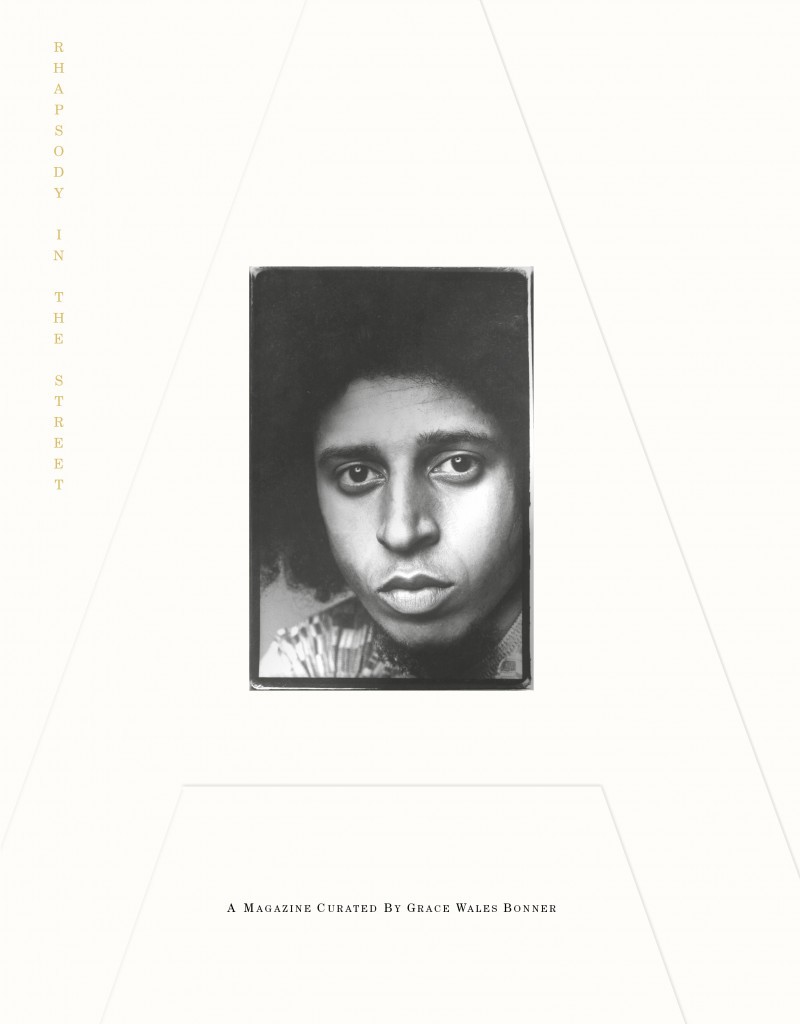
Opening A Magazine Curated By is the same as entering a different universe. With each issue, the magazine grants access to references that nourish a designer’s imagination.
As a child born of mixed heritage, I experience this difficulty in finding an in-between space, one that exists at the intersection of my Laotian and Comorian origins.
Fashion has become a way for me to search for this third space, where these questions of identity are suspended in favor of personal fulfillment. Within this world, my identity is no longer a burden; on the contrary, I feel that it allows me to reconcile the different facets of myself, shaped both by my scattered origins and by the culture of the country in which I was born.
Grace Wales Bonner is one of the designers who has helped me better understand the contours of my identity, to make sense of the different fragments that compose it, but above all to realize that this experience is shared by many people who must learn to navigate between the culture of the country in which they grew up and the one from which they originate.
So when I learned that Wales Bonner had curated an issue of A Magazine, buying it immediately felt like the obvious choice.
Similar to an exhibition curator, Wales Bonner introduces her influences throughout the magazine constructing page after page, a genuine dialogue between images and words, photographyand poetry.
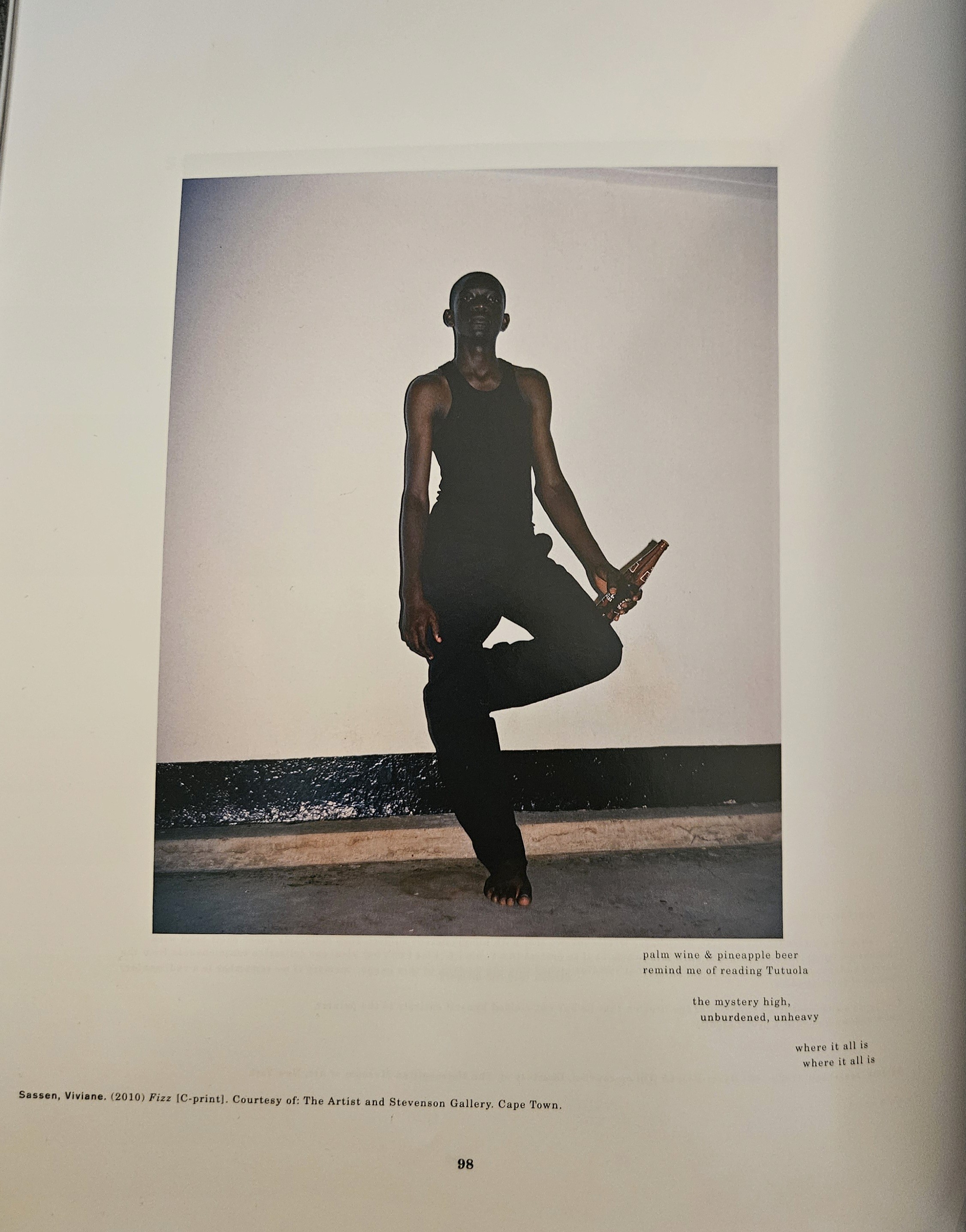
Viviane Sassen, Fizz, and a poem by Petero Kalule.
Among those pictures, I found one by the photographer Viviane Sassen, an artist whom I greatly appreciate for her graphic approach, which plays on color contrasts and geometric effects to structure our gaze. However, I am struck by the minimalism of the photograph Fizz. Here, the subject is not the photograph itself, but what is happening on the margins. The text, written by the poet Petero Kalule, offers an alternative interpretation of what Viviane Sassen’s photographic work might be.
Alongside the image, the text unfolds in three stanzas, two lines each. The poet evokes what the photograph inspires within him: memories and a sensation of lightness, reminding him of his beginnings, both as a poet and as a teenager discovering the pleasures of alcohol and Celebration.
Beyond the meaning of the words, the author Petero Kalule plays with typography and positioning to create movement, transforming the photograph itself. The spacing between the stanzas, along with the lightness and brevity of the text, conveys the feeling of a fleeting memory.
The addition of this text gives the image another meaning. Through the poem, the photograph becomes an archive, a memory of who the poet once was.
With this intimate poem, Petero Kalule offers us a perspective on the Black experience. This narrative is one of many featured in this issue of the magazine, where other poets and artists share their personal experiences. Together, these voices form a patchwork that captures the Afro-diasporic experience, moving between subjective realities and experiences shared across an entire community.
I find that this way of constructing the magazine echoes the way Grace Wales Bonner builds her collections; starting from individual experiences, whether those of major cultural figures like James Baldwin in the show Twilight Reveries, or lesser-known ones like Alessandro de' Medici, a métis child born from an illegitimate union between a servant and a member of the Medici family, in the collection Horizon Blues. Wales Bonner uses particular stories to construct the broader history of a community.
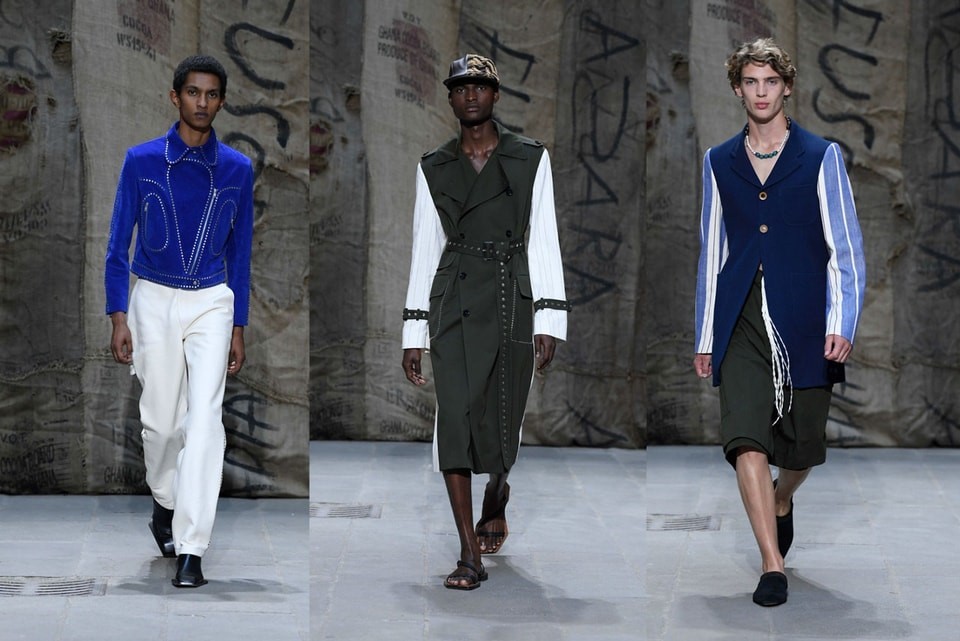
Grace Wales Bonner, Spring/Summer 2023 Horizon Blues: Medici Noir and Sankofa
In the Spring/Summer 2023 post-show video, Wales Bonner reveals the creative process behind the collection through the testimony of Ibrahim Mahama, who was responsible for the show’s set design. The video demonstrates how the set echoes not only the garments, but also the artist’s own history, as well as the history of the Medici Palace.
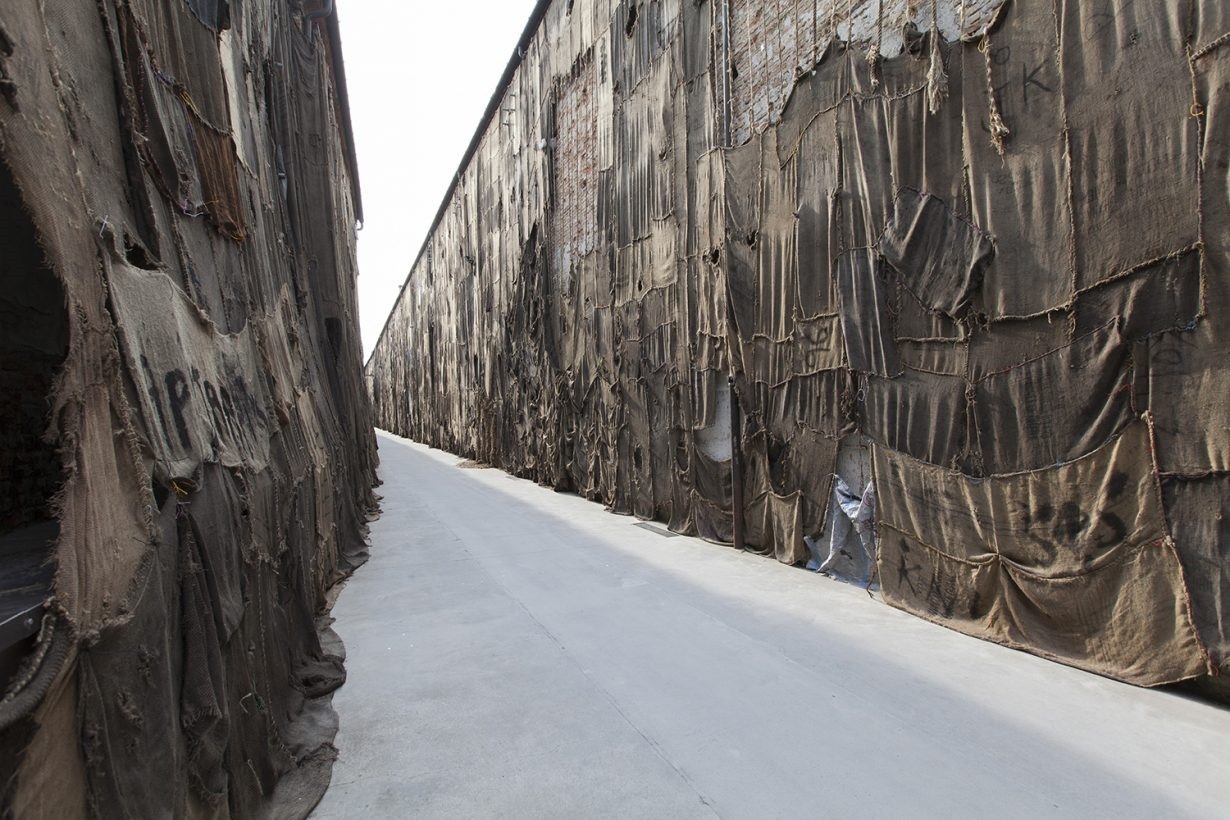
Out of Bounds, 2015 (installation view, 56th Venice Biennale, 2015)
The set was constructed entirely of cocoa sacks, recalling Ibrahim Mahama’s work for the Venice Biennale in 2015, where his monumental installation served as a critique of the West and the exploitation of resources from countries in the Global South.
For this runway show, the cocoa sacks drape the palace architecture while still allowing aspects of the facade to remain visible. Marked with inscriptions that seem to be names, perhaps those of the people who participated in the construction of the set, the sacks appear as traces of the past.
As the artist Ibrahim Mahama explains in the post-show video on the YouTube channel of Wales Bonner, migrants once had the habit of marking their names on their bodies and, later, on the objects they purchased after settling somewhere new.
Repeating in the Medici Palace what he did at Venice Biennale is, albeit anachronistic, a way of reminding us that immense Western fortunes could not have existed without exploitation and colonization. I see this gesture as a way to write an alternative history, one that includes the populations of the Global South within Western historical narratives. Grace Wales Bonner echoes the installation of Ibrahim Mahama, by proposing a revisited narrative in her show Horizon Blues, which pays tribute to Alessandro de' Medici, the first Black head of state to rule in the modern Western world, and the last one of the Medici's lineage.
The Medici family played a central role in shaping the cultural and economic power of Renaissance Florence. Through their immense wealth, largely built on banking and textile commerce, the Medici became influential patrons of the arts, supporting figures such as Michelangelo and Sandro Botticelli.
Through the reconstruction of what this black Medici wardrobe might have looked like, Grace reintroduces references to the Global South, where Indian macramé garments coexist with jacquard jackets from Charvet and suits from Savile Row.
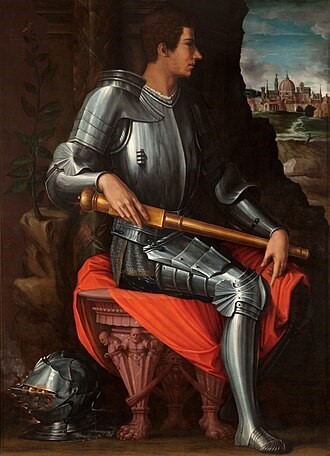
Giorgio Vasari, Portrait of Alessandro de’ Medici, c. 1534. Oil on canvas, 157 × 114 cm. Uffizi Gallery.
The color lapis lazuli blue is also highly present throughout the collection. Commonly found in Renaissance frescoes, it is recreated here by Wales Bonner using Ghanaian dyeing techniques.
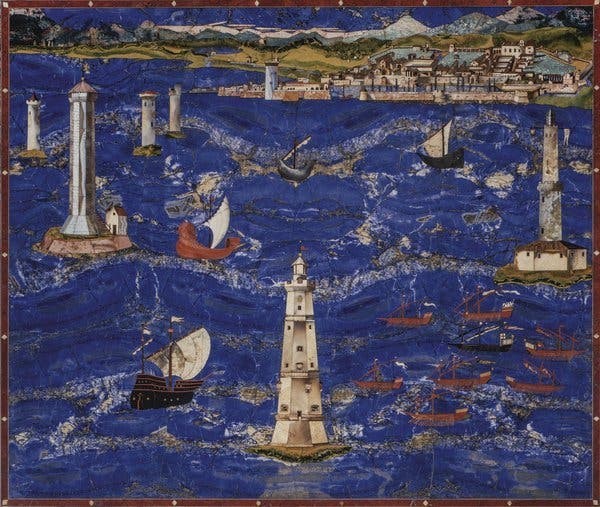
‘‘View of the Port of Livorno’’ (1601-1604), a table top by Cristofano Gaffuri from a design by Jacopo Ligozzi, Credit: Uffizi, Florence
Mother-of-pearl beads are also worn by several models, recalling their importance in sixteenth-century Italy, where they allowed elites to distinguish themselves. Here, they resonate with recycled beads sourced from Ghana.
Just as Ibrahim Mahama covers the walls of the Medici Palace with cocoa sacks from Ghana, Grace Wales Bonner imports techniques and accessories produced by this country to write new stories. Through this process, she connects two geographies and reconstructs a new narrative, in which the West and the Global South are interconnected.
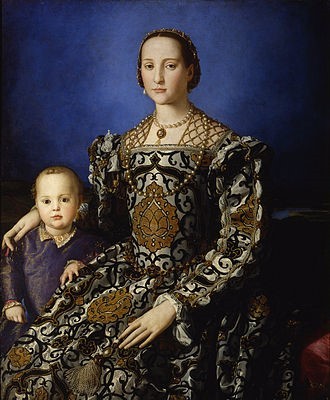
Bronzino, Portrait Bronzino, Portrait of Eleonora of Toledo and Her Son Giovanni de’ Medici, 1544
Within this artistic exchange between Grace Wales Bonner’s work and Ibrahim Mahama’s burlap sacks, the notion of Sankofa emerges. Sankofa is a term from the Twi language, spoken by the Akan people of Ghana, symbolized by a bird turning back onto itself.
The concept, which literally means “go back and retrieve it,” refers to the idea of returning to one’s origins and history in order to move forward into the future. In the show Horizon Blues, Wales Bonner returns to the Medici Palace in search of traces of Afro-descendant presence. Ibrahim Mahama participates in this movement by reminding viewers, through his burlap installations, of the way Western wealth was built through the sweat and labor of African countries.
Together, the two artists powerfully evoke both the corrupted origins of European wealth and the reality that such wealth could never have existed without Africa.
More than just a superficial interaction with a painful past, both artists use this historical immersion to propose a more glorious vision of Afro-descendant identities, by creating an entire wardrobe that would fit Alessandro de Medici.
Drawing from this painful history, Wales Bonner creates a collection entirely structured around Black excellence, embodied by the figure of Alessandro de’ Medici. In doing so, she proposes a “third space,” in the sense of Homi K. Bhabha: an alternative narrative in which Afro-descendant people are no longer relegated to the margins of history, but instead become its central protagonists.
The third space that Wales Bonner constructs in the show Horizon Blues is also present in the content of A Magazine Curated By. By inviting poets to collaborate on photographic documents through the practice of poetry and sharing intimate stories, Wales Bonner offers another vision of Afro-descendant identities. Whether from the African continent, the United States, or the Caribbean, these individuals embody what the term African Diaspora means.
Doc/34 all rights reserved, sponsored by IFM.
" height="65.65946764590899px" id="biO_icj08" transform="translate(0 1.371)" width="59.174572953517554px"/><path d="M 63.167 33.692 C 63.167 54.377 50.565 68.088 31.544 68.088 C 12.524 68.088 0 54.69 0 33.927 C 0 13.163 12.371 0 31.626 0 C 50.882 0 63.17 13.163 63.17 33.692 Z M 46.89 33.848 C 46.89 21.155 41.097 13.477 31.626 13.477 C 22.155 13.477 16.206 21.234 16.206 33.848 C 16.206 46.463 22.077 54.533 31.626 54.533 C 41.176 54.533 46.89 46.698 46.89 33.848 Z" fill="rgb(0, 0, 0)" height="68.08839784893921px" id="A8_8V8D77" transform="translate(58.705 0.196)" width="63.17042207703656px"/><path d="M 43.755 24.133 C 42.268 17.003 38.119 13.477 31.388 13.477 C 21.838 13.477 16.281 20.998 16.281 33.927 C 16.281 46.855 22.073 54.455 31.779 54.455 C 36.084 54.455 39.763 52.653 42.033 49.519 C 43.363 47.638 43.911 46.071 44.381 42.781 L 60.662 45.209 C 59.175 51.869 57.453 55.709 54.165 59.548 C 49.312 65.111 41.72 68.088 32.249 68.088 C 22.778 68.088 14.637 65.111 9.08 59.47 C 3.287 53.593 0 44.426 0 33.927 C 0 23.427 3.287 14.26 9.471 8.149 C 14.872 2.899 22.778 0 31.935 0 C 42.033 0 49.938 3.448 55.026 10.264 C 57.531 13.477 58.861 16.376 59.879 20.998 Z M 100.346 1.41 L 72.246 77.804 L 58.235 77.804 L 86.414 1.41 Z" fill="rgb(0, 0, 0)" height="77.80411839929134px" id="v1AksvdEb" transform="translate(121.519 0.196)" width="100.34629996240147px"/><path d="M 16.594 46.933 C 17.064 49.519 17.533 50.616 18.786 51.948 C 20.899 54.142 24.03 55.317 27.787 55.317 C 33.892 55.317 37.728 52.261 37.728 47.482 C 37.728 44.269 36.162 41.762 33.501 40.743 C 31.701 40.117 29.274 39.725 26.222 39.725 C 23.169 39.725 19.647 39.881 16.594 40.195 L 16.594 26.718 C 19.255 27.032 21.838 27.188 24.891 27.188 C 32.327 27.188 36.006 24.681 36.006 19.666 C 36.006 15.435 33.031 13.007 27.865 13.007 C 22.308 13.007 19.49 15.2 18.316 20.215 L 1.409 17.786 C 2.896 12.928 4.148 10.578 6.653 7.835 C 11.428 2.664 18.629 0 28.178 0 C 36.71 0 43.755 2.351 48.216 6.66 C 51.112 9.559 52.6 13.32 52.6 17.786 C 52.6 26.091 48.138 31.263 39.137 33.378 C 43.911 34.083 46.494 35.18 49.234 37.531 C 52.521 40.508 54.4 44.583 54.4 49.127 C 54.4 53.123 53.304 56.806 51.269 59.548 C 49.547 61.899 46.807 64.092 43.911 65.424 C 39.841 67.305 33.501 68.48 27.63 68.48 C 20.586 68.48 13.541 66.835 9.393 64.092 C 5.792 61.742 3.053 58.294 1.331 53.985 C 0.861 52.888 0.548 51.869 0 49.832 Z" fill="rgb(19, 136, 8)" height="68.48016075605614px" id="UrmKxPWFQ" transform="translate(219.752 0)" width="54.399905030019454px"/><path d="M 0 37.844 C 2.348 35.233 4.853 32.36 7.514 29.226 L 24.5 9.324 C 28.257 5.015 29.744 3.056 31.779 0 L 47.825 0 C 47.355 4.623 47.199 7.757 47.199 13.007 L 47.199 38.471 L 49.469 38.471 C 51.895 38.471 54.478 38.236 57.218 37.844 L 57.218 52.104 C 54.87 51.791 51.973 51.634 49.547 51.634 L 47.199 51.634 L 47.199 55.552 C 47.199 59.94 47.355 62.212 47.825 65.189 L 31.701 65.189 C 32.092 62.525 32.327 59.235 32.327 55.395 L 32.327 51.556 L 10.176 51.556 C 5.088 51.556 2.896 51.634 0 51.869 Z M 32.405 29.539 C 32.405 26.013 32.562 21.704 32.875 18.256 C 31.309 20.45 30.135 22.017 28.022 24.681 L 16.594 38.628 L 32.405 38.628 Z" fill="rgb(19, 136, 8)" height="65.18935212489366px" id="nz3MAn0g5" transform="translate(272.782 1.567)" width="57.21774185674667px"/></g></svg>)