Reflections
61st Venice Biennale: A biennale with no stance ?
By Dylan Hamada
Every two years, the Venice Biennale transforms the city of doges into the world capital of contemporary art. Created in 1895, it brings together national pavilions from around the world, where each state is invited to present a vision of its artistic creation. But reducing the Biennale to a simple international exhibition would be a mistake. Its influence, and the fact that it gathers countries from all over the world in a single place, makes it a theater of geopolitical stakes.

This year's edition demonstrated this once again. Even before it opened, debates crystallized around the presence of the Russian and Israeli pavilions, a reminder that the Biennale is also a site for the tensions running through the world. National pavilions are not simple exhibition spaces: whether they intend to or not, they embody an image of the states they represent, and they carry the expectations of a public seeking positions on major contemporary issues.
Yet another observation struck me over the course of my visit. Beyond the controversies tied to the presence of certain countries, it was the content of the pavilions of the great Western powers that surprised me, through their caution. While the international context is marked by conflicts, climate upheavals, and profound questioning of political and societal balances, several of the major economic powers choose not to address those subjects and instead speak about abstract themes. Conversely, some pavilions of nations with less economic and political power on the international stage, like the Austrian pavilion or the Czech and Slovak pavilion, carried assertive, more embodied and unsettling messages.

You must have seen on social media those naked women performing in what seems like a bathtub, during the opening of the Biennale. The performance, titled Sea World Venice, occurs in the Austrian pavilion, where our urine fills an aquarium in which a woman lives. Florentina Holzinger, in a spectacular, if not provocative, way, creates a metaphor for how our filth—CO2 emissions and all the waste coming from industries—is responsible for rising sea levels and the disappearance of Venice. Less spectacular, but as meaningful, the Czech and Slovak pavilion offers us, through the short film Silence of the Mole — where we see the evolution of a childhood character becoming more and more instrumentalized by political and capitalist forces — a metaphor for how cultural figures specific to one country can become instruments of political forces and lose, at the same time, their original meaning.
As though, at the 61st Venice Biennale, artistic boldness didn't come from the center, but from its margins. In this Biennale, three pavilions struck me with this contrasting approach. The French and American pavilions both proposed an approach centered on the concepts of time and elevation, with plastic artworks based around sculptures and accumulations of objects eroded by time, without really addressing the context in which they exist. Inversely, the Serbian pavilion deliberately returned to history and the traumatic events that marked the twentieth century, with a collage of twentieth-century traces — maps, family photographs, news clippings from various national newspapers — opening a reflection on what becomes of our collective narratives, how a shared culture can be constructed and what we choose to preserve in shaping our understanding of history.
The French Pavilion – Comme Saturne: Exploring the Dialectic Between Destruction and Creation Through Art
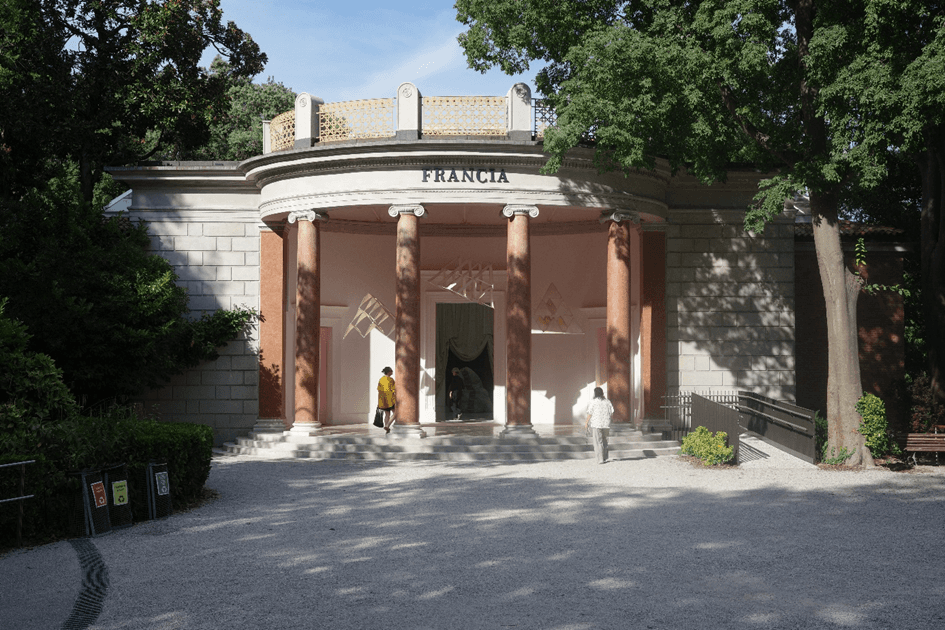
The French pavilion presents itself as a vast cabinet of curiosities where materials, narratives, and references overlap. At its core lies the textile technique of "dévoré," which consists of applying acid to a fabric to burn away certain fibers and create new forms. This has led the artist to Saturn, the god who, in myth, devours his own children, and to the idea that his destructive power might also serve as fertile ground for creation. As the exhibition's curator put it in an interview with the art critic Margaux Brugvin, thinking of creation and destruction as a dialectic is for Yto Barrada a way of responding to our troubled times.
Yet the exhibition rarely makes this connection explicit. Instead, the elements gathered throughout the pavilion often feel juxtaposed rather than genuinely interconnected. References to Delphine Seyrig, the actress who starred in Jacques Demy's Donkey Skin, stand alongside a mural decoration representing the musical notes of a barrel organ, which represents a rendition of La Marseillaise in a more revolutionary key, and a wool curtain that fades over time. Visitors move from one reference to another without fully understanding what binds them together or, more importantly, what the exhibition ultimately seeks to challenge. Ideas such as revolution, overturning established orders, or criticizing Western systems of representation are introduced but never fully developed.
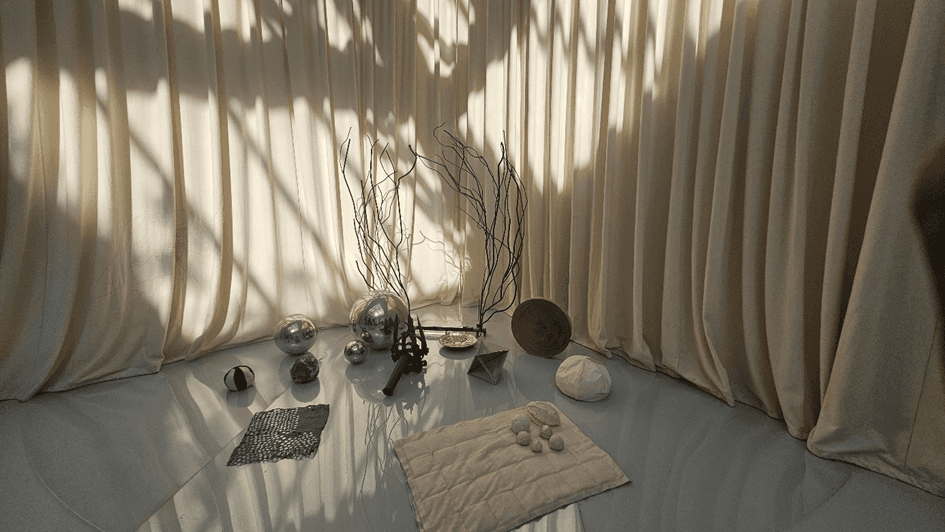
What annoys me about the French pavilion's proposition is that the concept of creative destruction and the rise of Saturn as a central concept sounds like a pretext to stick together heterogeneous elements rather than a key idea that helps us understand a global proposition. This is especially striking when entering the first room of the national pavilion. Elements related to the movie Donkey Skin are connected to musical notes of the barrel organ above a wool curtain; the latter seems to be an aesthetic experiment on how the sun affects the fading of materials. All of these artworks are indeed about some form of creative destruction, but they don't tell the same story. While the reference to Jacques Demy seems to be a homage, the use of La Marseillaise looks like an attempt to fuel the artistic proposition with political meaning. However, put above the wool curtain, the defiant essence of this sheet music is almost invisible. Like these musical notes, the potential political statement that could arise from this destruction/creation dialectic is elusive.
The United States Pavilion – Call Me the Breeze: Elevation as a Universal Horizon
Among the pavilions where I found the connection between the concept of the artwork and the material representation tenuous, there is Call Me the Breeze, an exhibition devoted to the American sculptor Alma Allen. Known for his sculptures mimicking natural phenomena, the artist fills the pavilion with sculptures in bronze, stone, and wood. Their elongated silhouettes appear as though slowly shaped by the centuries. These irregular masses evoke both geological formations and living organisms, as if polished by water or erosion.
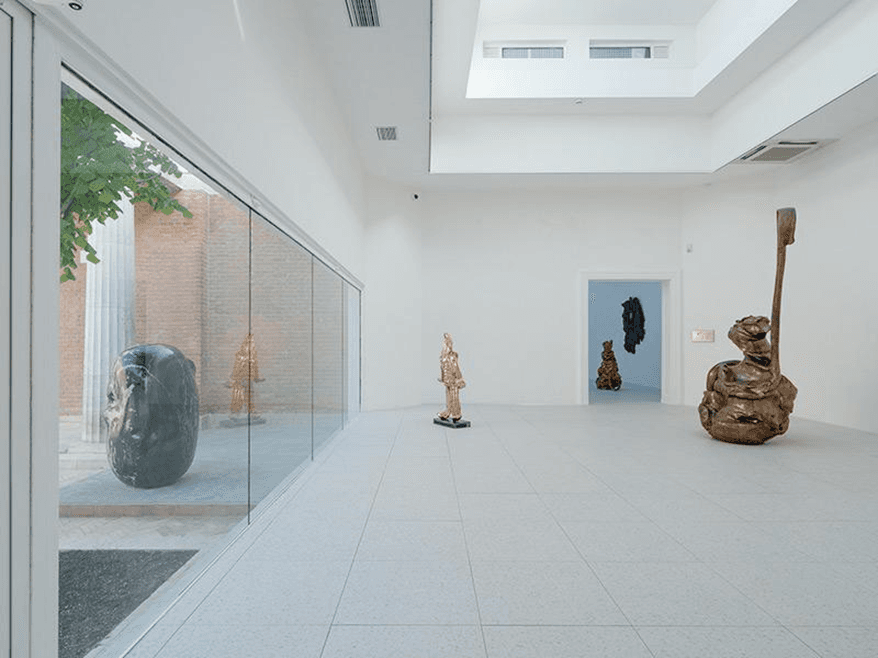
The curatorial framing presents the exhibition as a reflection on elevation, understood both as physical upward movement and as a metaphor for collective optimism and self-transcendence. The sculptures do indeed seem to pull themselves from the ground, stretching toward the sky, inviting the viewer to contemplate a form of transcendence.
But when I was wandering through the pavilion, a sentiment of vacuity couldn’t get away from me. It seemed like those biomorphic forms were not connected to our contemporary world, not even our humanity. It was like this concept of elevation was more appropriate to describe vegetal or geological phenomena rather than the essence of the human condition.
I was expecting more from the United States Pavilion, as this country is at the center of major political changes and cultural changes under the Trump administration. With that said, I might have expected too much from a pavilion where US officials wanted to use it as a way to promote country values.
Indeed, this pavilion promoted self-transcendence, which is a value that we could attach to meritocracy and ultimately, capitalism. However, the way this exhibition shows this value, through abstract sculptures that are almost like aliens, disconnected from Earth and human realities, might be a way for the artist to respect the constraints he has without fully acknowledging it.
The statement of Alma Allen, he gave in the media Oculus, “I don’t believe in American exceptionalism, but I do believe in the power of ambiguity, and I know that viewers who understand my work won’t be put off by hateful things people said or need to view my work through the politics of the moment” seems to suggest that the artist did not want to promote the United States, nor did he (could he ?) want to be a direct critic of the country he was representing
Here, the vacuity of meaning can be seen as a way to weaken the relevance of meritocracy, without getting censored.
Taken together, these two pavilions reveal a broader tendency among some of the Biennale's most prominent national representations. If the lack of a real backbone in France's pavilion appears to be a way to skip conversations around contemporary topics, the work of Alma Allen for the US pavilion can be seen as a way to avoid censorship. Whether this restriction comes from the artist or from external pressure, it appears that having a strong statement, as an artist from a former colonial power, is harder nowadays.
Meanwhile, countries less prominent on the international scene, like Serbia, seize that blank space to propose a more direct commentary on our modern world
The Serbian Pavilion: Through Golgotha to resurrection – and how to use archive, not as a political means for nationalist discourse, but for a multicultural perspective on history
The Serbian Pavilion, with its exhibition Through Golgotha Resurrection, imagined by the artist Predrag Djaković, is an example of a more engaging and rooted contemporary work of art.
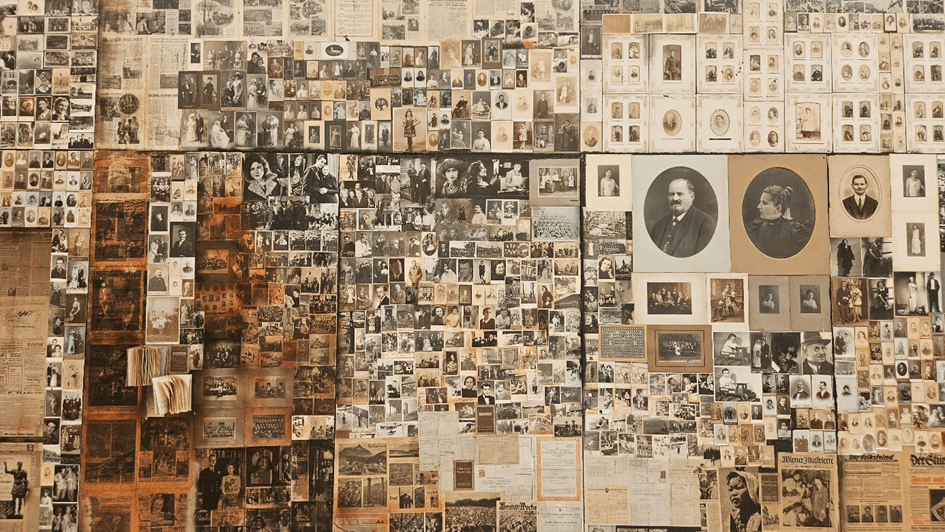
When you enter the Serbian pavilion, your eyes are seized by an immense wall of archives. Photographs, maps, newspaper clippings, and administrative documents form a vast constellation of historical fragments. Yellowed by time, torn, curling at the edges, and sometimes peeling away from the wall, these documents appear to be disintegrating before the visitor's eyes. Family photographs from the former Yugoslavia stand alongside Italian newspaper headlines and archival material gathered from across Europe. The installation offers neither chronology nor geographical hierarchy. Instead, it immerses us in a fragmented visual landscape, where the traces of the twentieth century coexist without being organized into a single historical narrative.
This fragile materiality isn’t incidental. The artist does not present the archive as a stable repository of the past, but as something permanently threatened by disappearance. The deteriorating condition of the documents and their decaying surfaces makes visible the vulnerability of collective memory itself. In this respect, the installation recalls Jacques Derrida's concept of Mal d'archive. For Derrida, the archive is never a neutral container of history. It exists in a constant tension between preservation and destruction, between remembrance and erasure. Every archive carries within itself the possibility of its own disappearance, while remaining subject to the political powers that determine what deserves to be preserved and what can be forgotten. By exhibiting archives already marked by the passage of time, the artist seems less interested in reconstructing the past than in preserving the fragile traces of Europe's traumatic twentieth century before they disappear altogether.
I see the mobilisation of the mal d’archive concept as a way to warn us. A warning about what is preserved and what is deliberately left unsaid. Standing in this pavilion, I cannot help but think of those of the major nations, whose exhibitions seem to have erased their own histories. By presenting ethereal works detached from the realities of the contemporary world, it is as if countries such as the United States and France seek to prevent visitors from confronting the conflicts that continue to shape our present or from remembering the scars left by the twentieth century. Beside these pavilions, however, survive the archives preserved by Predrag Djaković. Rather than imposing a single narrative, the artist invites us to question what we are beginning to forget and the danger that such forgetting may entail, through the exhibition of journal front pages showing the rise of totalitarian regimes.
Without descending into fatalism, Through Golgotha to Resurrection evokes, with its reference to the site of Christ's crucifixion, the possibility of another future. The failures and suffering of the past should not serve as reasons for lamentation, but as foundations upon which to rebuild a shared future. Djaković does not prescribe what this future should look like; instead, he encourages us to look back at our collective past in order to imagine other possibilities.
If the Serbian Pavilion does not ignore the world in which it exists, one might nevertheless criticize it for not engaging more directly with the history of its own region. Indeed, Djaković's work draws upon the collective memory of an entire continent, making it difficult to argue that it is specifically representative of Serbian culture. Yet this deliberate choice allows the artist to introduce a concept that is central to interpreting the exhibition: parochialism.
As a key concept running throughout the work of Radomir Konstantinović, parochialism describes the tendency of a community to become attached to itself, enclosed within its own worldview, and resistant to what lies beyond its boundaries. Rather than celebrating national identity, Djaković's exhibition implicitly challenges this inward-looking mentality by proposing memory as a shared European concern, one that transcends national borders and reminds us that the preservation of the past is a collective responsibility.
In his philosophy, Konstantinović describes parochialism not simply as attachment to one's local community, but as a closed intellectual and political attitude that reduces reality to a single identity while rejecting complexity, plurality, and difference. Such a mindset ultimately creates the conditions for exclusion and nationalism. By refusing to privilege a single national narrative and by assembling archives from across Europe, the Serbian pavilion proposes precisely the opposite. It presents memory as something fundamentally shared and interconnected, suggesting that the tragedies of the twentieth century belong to no single nation alone. At a moment when nationalist movements and extremist political discourses are once again gaining ground across Europe, this gesture acquires a striking contemporary relevance. Rather than commemorating the past for its own sake, the pavilion asks whether Europe is still capable of learning from its own history.
Conclusion:
What this year's Biennale ultimately reveals is a paradox at the heart of the exhibition's own premise. The event was conceived, from its origins, as a stage on which nations could project an image of themselves to the world — yet the pavilions that seemed most eager to occupy that stage, France and the United States chief among them, were also the most reluctant to say anything at all. Their caution was not accidental; it reflected a broader unease among established powers when asked to translate political and historical turbulence into a clear artistic statement. Abstraction, in this context, functions less as an aesthetic choice than as a form of self-protection.
The Serbian pavilion suggests that another path remains possible. By choosing to confront rather than forget history, by treating memory as fragile, shared, and unfinished rather than settled, Djaković's work reminds us that a national pavilion can still be a space of genuine reflection rather than mere representation. Its strength lies not in offering answers, but in refusing the comfort of silence.
Notes :
1: “as something that is common to many, that exists among them, that separates and binds them, that appears differently to each person, and that can only be understood to the extent that many people discuss it and exchange their opinions and perspectives with one another. It is only in the freedom of discussion that the world generally appears as that which is being discussed, in its objectivity, visible from all sides.” Arendt H. Qu’est-ce que la politique. Points/Seuil. 2001. Fragment 3b
Doc/34 all rights reserved, sponsored by IFM.
" height="65.65946764590899px" id="biO_icj08" transform="translate(0 1.371)" width="59.174572953517554px"/><path d="M 63.167 33.692 C 63.167 54.377 50.565 68.088 31.544 68.088 C 12.524 68.088 0 54.69 0 33.927 C 0 13.163 12.371 0 31.626 0 C 50.882 0 63.17 13.163 63.17 33.692 Z M 46.89 33.848 C 46.89 21.155 41.097 13.477 31.626 13.477 C 22.155 13.477 16.206 21.234 16.206 33.848 C 16.206 46.463 22.077 54.533 31.626 54.533 C 41.176 54.533 46.89 46.698 46.89 33.848 Z" fill="rgb(0, 0, 0)" height="68.08839784893921px" id="A8_8V8D77" transform="translate(58.705 0.196)" width="63.17042207703656px"/><path d="M 43.755 24.133 C 42.268 17.003 38.119 13.477 31.388 13.477 C 21.838 13.477 16.281 20.998 16.281 33.927 C 16.281 46.855 22.073 54.455 31.779 54.455 C 36.084 54.455 39.763 52.653 42.033 49.519 C 43.363 47.638 43.911 46.071 44.381 42.781 L 60.662 45.209 C 59.175 51.869 57.453 55.709 54.165 59.548 C 49.312 65.111 41.72 68.088 32.249 68.088 C 22.778 68.088 14.637 65.111 9.08 59.47 C 3.287 53.593 0 44.426 0 33.927 C 0 23.427 3.287 14.26 9.471 8.149 C 14.872 2.899 22.778 0 31.935 0 C 42.033 0 49.938 3.448 55.026 10.264 C 57.531 13.477 58.861 16.376 59.879 20.998 Z M 100.346 1.41 L 72.246 77.804 L 58.235 77.804 L 86.414 1.41 Z" fill="rgb(0, 0, 0)" height="77.80411839929134px" id="v1AksvdEb" transform="translate(121.519 0.196)" width="100.34629996240147px"/><path d="M 16.594 46.933 C 17.064 49.519 17.533 50.616 18.786 51.948 C 20.899 54.142 24.03 55.317 27.787 55.317 C 33.892 55.317 37.728 52.261 37.728 47.482 C 37.728 44.269 36.162 41.762 33.501 40.743 C 31.701 40.117 29.274 39.725 26.222 39.725 C 23.169 39.725 19.647 39.881 16.594 40.195 L 16.594 26.718 C 19.255 27.032 21.838 27.188 24.891 27.188 C 32.327 27.188 36.006 24.681 36.006 19.666 C 36.006 15.435 33.031 13.007 27.865 13.007 C 22.308 13.007 19.49 15.2 18.316 20.215 L 1.409 17.786 C 2.896 12.928 4.148 10.578 6.653 7.835 C 11.428 2.664 18.629 0 28.178 0 C 36.71 0 43.755 2.351 48.216 6.66 C 51.112 9.559 52.6 13.32 52.6 17.786 C 52.6 26.091 48.138 31.263 39.137 33.378 C 43.911 34.083 46.494 35.18 49.234 37.531 C 52.521 40.508 54.4 44.583 54.4 49.127 C 54.4 53.123 53.304 56.806 51.269 59.548 C 49.547 61.899 46.807 64.092 43.911 65.424 C 39.841 67.305 33.501 68.48 27.63 68.48 C 20.586 68.48 13.541 66.835 9.393 64.092 C 5.792 61.742 3.053 58.294 1.331 53.985 C 0.861 52.888 0.548 51.869 0 49.832 Z" fill="rgb(19, 136, 8)" height="68.48016075605614px" id="UrmKxPWFQ" transform="translate(219.752 0)" width="54.399905030019454px"/><path d="M 0 37.844 C 2.348 35.233 4.853 32.36 7.514 29.226 L 24.5 9.324 C 28.257 5.015 29.744 3.056 31.779 0 L 47.825 0 C 47.355 4.623 47.199 7.757 47.199 13.007 L 47.199 38.471 L 49.469 38.471 C 51.895 38.471 54.478 38.236 57.218 37.844 L 57.218 52.104 C 54.87 51.791 51.973 51.634 49.547 51.634 L 47.199 51.634 L 47.199 55.552 C 47.199 59.94 47.355 62.212 47.825 65.189 L 31.701 65.189 C 32.092 62.525 32.327 59.235 32.327 55.395 L 32.327 51.556 L 10.176 51.556 C 5.088 51.556 2.896 51.634 0 51.869 Z M 32.405 29.539 C 32.405 26.013 32.562 21.704 32.875 18.256 C 31.309 20.45 30.135 22.017 28.022 24.681 L 16.594 38.628 L 32.405 38.628 Z" fill="rgb(19, 136, 8)" height="65.18935212489366px" id="nz3MAn0g5" transform="translate(272.782 1.567)" width="57.21774185674667px"/></g></svg>)